Python, Go, Rust, TypeScript and AI with Armin Ronacher
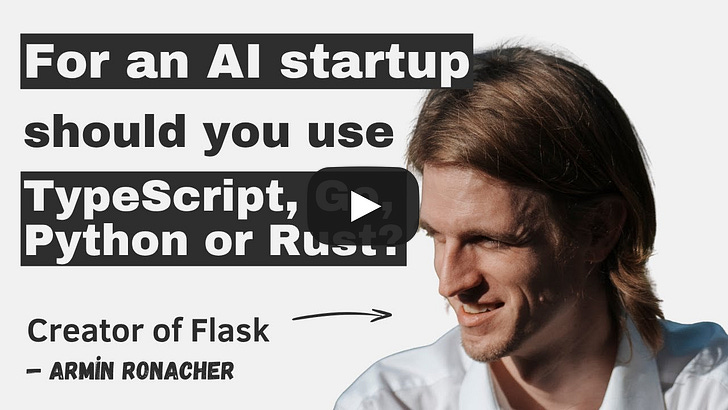
Python, Go, Rust, TypeScript and AI with Armin RonacherFor an AI startup today, what language would be the best choice? Flask creator and former Sentry engineer Armin Ronacher discusses this, and how AI is changing how he now builds software.
Stream the latest episodeListen and watch now on YouTube, Spotify, and Apple. See the episode transcript at the top of this page, and timestamps for the episode at the bottom. Brought to You by• Statsig — The unified platform for flags, analytics, experiments, and more. Most teams end up in this situation: ship a feature to 10% of users, wait a week, check three different tools, try to correlate the data, and you’re still unsure if it worked. The problem is that each tool has its own user identification and segmentation logic. Statsig solved this problem by building everything within a unified platform. Check out Statsig. • Linear – The system for modern product development. In the episode, Armin talks about how he uses an army of “AI interns” at his startup. With Linear, you can easily do the same: Linear’s Cursor integration lets you add Cursor as an agent to your workspace. This agent then works alongside you and your team to make code changes or answer questions. You’ve got to try it out: give Linear a spin and see how it integrates with Cursor. — In this episodeFor an AI startup today, what language would be the best choice: Python, TypeScript, Go or Rust? Armin Ronacher is the creator of the Flask framework for Python, was one of the first engineers hired at Sentry, and now the co-founder of a new startup. He has spent his career thinking deeply about how tools shape the way we build software. In this episode of The Pragmatic Engineer Podcast, he joins me to talk about how programming languages compare, why Rust may not be ideal for early-stage startups, and how AI tools are transforming the way engineers work. Armin shares his view on what continues to make certain languages worth learning, and how agentic coding is driving people to work more, sometimes to their own detriment. We also discuss:
Jump to interesting parts:
 Interesting quotes from the episodeOn how Armin uses AI tools (at 28:05)
Why Armin wants to hire more engineers at his startup, despite using an “army of AI interns” until now (at 33:48:)
Why Armin doesn’t believe strongly typed languages like TypeScript meaningfully reduce errors — based on his experience observing this at Sentry (at 52:42:)
The Pragmatic Engineer deepdives relevant for this episodeTimestamps(00:00) Intro (01:34) Why the Python 2 to 3 migration created so many challenges (06:53) How Python, Go, and Rust stack up and when to use each one (08:35) The friction points that make Rust a bad fit for startups (12:28) How Armin thinks about choosing a language for building a startup (22:33) How AI is impacting the need for unified code bases (24:19) The use cases where AI coding tools excel (30:08) Why Armin has changed his mind about AI tools (38:04) Why different programming languages still matter but may not in an AI-driven future (42:13) Why agentic coding is driving people to work more and why that’s not always good (47:41) Armin’s error-handling takeaways from working at Sentry (50:32) How important is language choice from an error-handling perspective (56:02) Why the current SDLC still doesn’t prioritize error handling (1:04:18) The challenges language designers face (1:05:40) What Armin learned from working in startups and who thrives in that environment (1:11:39) Rapid fire round ReferencesWhere to find Armin Ronacher: • LinkedIn: https://www.linkedin.com/in/arminronacher/ • Website: https://mitsuhiko.at/ • Blog: https://lucumr.poco Mentions during the episode: • Flask: https://flask.palletsprojects.com/en/stable/ • Sentry: https://sentry.io/ • Python: The Documentary:  • Rust: https://www.rust-lang.org/ • Go: https://go.dev/ • WebAssembly: https://webassembly.org/ • JavaScript: https://en.wikipedia.org/wiki/JavaScript • TypeScript: https://www.typescriptlang.org/ • React: https://react.dev/ • Claude Code: https://www.claude.com/product/claude-code • CodeX: https://openai.com/codex/ • 996: https://lucumr.pocoo.org/2025/9/4/996/ • Peter Steinberger on LinkedIn: https://www.linkedin.com/in/steipete/ • Ron Pressler: https://inside.java/u/RonPressler/ • Debian: https://www.debian.org/ • Red Hat: https://www.redhat.com/ — Production and marketing by Pen Name. You’re on the free list for The Pragmatic Engineer. For the full experience, become a paying subscriber. Many readers expense this newsletter within their company’s training/learning/development budget. If you have such a budget, here’s an email you could send to your manager. This post is public, so feel free to share and forward it. If you enjoyed this post, you might enjoy my book, The Software Engineer's Guidebook. Here is what Tanya Reilly, senior principal engineer and author of The Staff Engineer's Path said about it:
|

%26stroke%3Dnone%26strokeWidth%3D3.6)


Comments
Post a Comment