The history of servers, the cloud, and what’s next – with Oxide
The history of servers, the cloud, and what’s next – with OxideBryan Cantrill explains how decades of server and cloud evolution shaped modern infrastructure and what today's software engineers can learn from it.
Stream the latest episodeListen and watch now on YouTube, Spotify, and Apple. See the episode transcript at the top of this page, and timestamps for the episode at the bottom. Brought to You by
• Statsig — The unified platform for flags, analytics, experiments, and more. Companies like Meta and Google had to build their own infrastructure for safer deployments and experimentation. Statsig makes this advanced tooling accessible to everyone. They have a generous free tier, a $50K startup program, and affordable enterprise plans. Check it out. • Linear — The system for modern product development. We know that AI will be part of the software stack — in fact, it already is, today. To support AI agents, Linear they built an open API and SDK that lets any agent plug into your issue tracker. You can also connect popular agents like ike Cursor, GitHub Copilot, OpenAI Codex, and others. Take a look at how Linear works with agents. In this episodeHow have servers and the cloud evolved in the last 30 years, and what might be next? Bryan Cantrill was a distinguished engineer at Sun Microsystems during both the Dotcom Boom and the Dotcom Bust. Today, he is the co-founder and CTO of Oxide Computer, where he works on modern server infrastructure. In this episode of The Pragmatic Engineer, Bryan joins me to break down how modern computing infrastructure evolved. We discuss why the Dotcom Bust produced deeper innovation than the Boom, how constraints shape better systems, and what the rise of the cloud changed and did not change about building reliable infrastructure. Our conversation covers early web infrastructure at Sun, the emergence of AWS, Kubernetes and cloud neutrality, and the tradeoffs between renting cloud space and building your own. We also touch on the complexity of server-side software updates, experimenting with AI, the limits of large language models, and how engineering organizations scale without losing their values. If you want a systems-level perspective on computing that connects past cycles to today’s engineering decisions, this episode offers a rare long-range view. 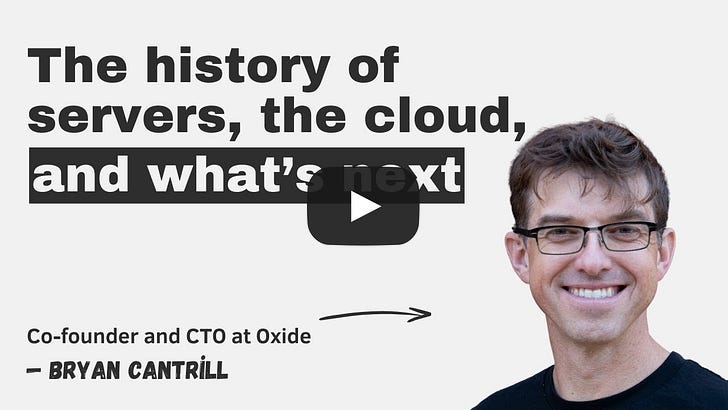 Interesting sections from the episodeHow the “Dotcom Bust” brought more tech creativity than the “Boom.” As Bryan recalled (starting at 14:53), memories from the Dotcom Boom and Bust:
How Jeff Bezos tricked everyone with AWS pricing. Bryan was running a small competitor to AWS called Joyent, and so he knew something about AWS pricing that the rest of the world was yet to catch up to (starting at 26:07)
Why Kubernetes might have become really popular, in part thanks to AWS. Bryan, starting at 27:42:
Interesting: Oxide found it hard to hire hardware engineers who are principles-first, and folks who can build hardware without a “reference design” available. Turns out, building a new type of computer like Oxide means creating hardware from scratch, instead of using “reference designs.” Many hardware engineers are simply not used to doing this:
Bryan initially struggled to find the “right” electrical engineers — until Bryan shared in an article that they paid everyone at Oxide a $175,000 base salary in 2021 (today, this number is $235,000 today.) This article got shared inside hardware engineering circles, and suddenly they got standout electrical engineers applying — who often have not built computers before, but have been designing electrical equipmen and hardware from zero in other fields. The Pragmatic Engineer deepdives relevant for this episodeTimestamps(00:00) Intro (01:26) Computer science in the 1990s (03:01) Sun and Cisco’s web dominance (05:41) The Dotcom Boom (10:26) From Boom to Bust (15:32) The innovations of the Bust (17:50) The open source shift (22:00) Oracle moves into Sun’s orbit (24:54) AWS dominance (2010–2014) (28:15) How Kubernetes and cloud neutrality (30:58) Custom infrastructure (36:10) Renting the cloud vs. buying hardware (45:28) Designing a computer from first principles (50:02) Why everyone is paid the same salary at Oxide (54:14) Oxide’s software stack (58:33) The evolution of software updates (1:02:55) How Oxide uses AI (1:06:05) The limitations of LLMs (1:11:44) AI use and experimentation at Oxide (1:17:45) Oxide’s diverse teams (1:22:44) Remote work at Oxide (1:24:11) Scaling company values (1:27:36) AI’s impact on the future of engineering (1:31:04) Bryan’s advice for junior engineers (1:34:01) Book recommendations ReferencesWhere to find Bryan Cantrill: • LinkedIn: https://www.linkedin.com/in/bryan-cantrill-b6a1 • Website: https://bcantrill.dtrace.org Mentions during the episode: • Sun Microsystems: https://en.wikipedia.org/wiki/Sun_Microsystems • Oxide Computer: https://oxide.computer • Linux: https://www.linux.org • Haiku: https://www.haiku-os.org • Gnu Hurd: https://en.wikipedia.org/wiki/GNU_Hurd • Duke Nukem: https://en.wikipedia.org/wiki/Duke_Nukem • Greg Papadopoulos: https://en.wikipedia.org/wiki/Greg_Papadopoulos • Dave Pacheco’s talk, as linked to in Bryan’s blog entry: https://oxide.computer/blog/systems-software-in-the-large • Gilded Age: https://en.wikipedia.org/wiki/Gilded_Age • 1950 Château d’Yquem: https://www.wine-searcher.com/find/d+yquem+sauternes+bordeaux+france/1950 • Pets.com: https://en.wikipedia.org/wiki/Pets.com • Webvan: https://en.wikipedia.org/wiki/Webvan • Jeff Bonwick on LinkedIn: https://www.linkedin.com/in/jeff-bonwick-80b4b51 • CFS: https://en.wikipedia.org/wiki/Clustered_file_system • SPARC: https://en.wikipedia.org/wiki/SPARC • X86: https://en.wikipedia.org/wiki/X86 • LISA11 - Fork Yeah! The Rise and Development of illumos: 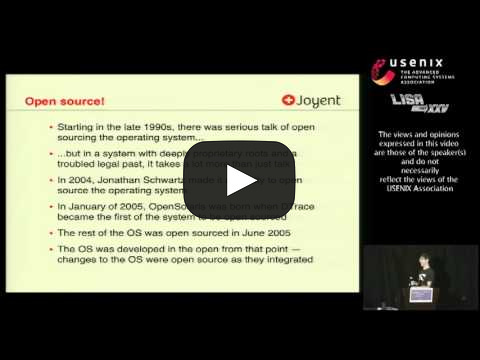 • Larry Ellison: https://en.wikipedia.org/wiki/Larry_Ellison • Oxide’s blog entry on their $100M Series B: https://oxide.computer/blog/our-100m-series-b • Bryan Cantrill from Joyent on Manta: internet-facing object storage facility that features compute:  • Jeff Bezos on X: https://x.com/JeffBezos • Kubernetes: https://kubernetes.io • How Kubernetes is Built with Kat Cosgrove: https://newsletter.pragmaticengineer.com/p/how-kubernetes-is-built-with-kat • Craig McLuckie on LinkedIn: https://www.linkedin.com/in/craigmcluckie • Cloud Native Computing Foundation: https://www.cncf.io • The Datacenter as a Computer: Designing Warehouse-Scale Machines: https://www.amazon.com/Datacenter-Computer-Designing-Warehouse-Scale-Architecture/dp/303100633X • Startups on hard mode: Oxide. Part 1: Hardware: https://newsletter.pragmaticengineer.com/p/oxide • Oxide’s Compensation Model: How is it Going?: https://oxide.computer/blog/oxides-compensation-model-how-is-it-going • Gumroad: https://gumroad.com • Oxide on Github: https://github.com/oxidecomputer • Omicron: https://github.com/oxidecomputer/omicron • OxCon 2025: Update on Update:  • Intelligence is not Enough | Bryan Cantrill | Monktoberfest 2023:  • Richard Sutton’s on LLMs as a dead end:  • Liron reacts to “Intelligence Is Not Enough” by Bryan Cantrill:  • Smoke test: https://en.wikipedia.org/wiki/Smoke_testing_(software) • Python, Go, Rust, TypeScript and AI with Armin Ronacher: https://newsletter.pragmaticengineer.com/p/python-go-rust-typescript-and-ai • Richard Sutton on X: https://x.com/RichardSSutton • Rust: https://rust-lang.org • Open Source LLMs with Simon Willison: https://oxide-and-friends.transistor.fm/episodes/open-source-llms-with-simon-willison • Founder Mode: https://paulgraham.com/foundermode.html • Oxide and Friends episode, Reflecting on Founder Mode: https://oxide-and-friends.transistor.fm/episodes/reflecting-on-founder-mode • The Soul of a New Machine: https://www.amazon.com/Soul-New-Machine-Tracy-Kidder/dp/0316491977 • Skunk Works: A Personal Memoir of My Years at Lockheed: https://www.amazon.com/Skunk-Works-Personal-Memoir-Lockheed/dp/0316743003 • Steve Jobs & the Next Big Thing: https://www.amazon.com/Steve-Jobs-Next-Big-Thing/dp/0689121350 — Production and marketing by Pen Name. You’re on the free list for The Pragmatic Engineer. For the full experience, become a paying subscriber. Many readers expense this newsletter within their company’s training/learning/development budget. If you have such a budget, here’s an email you could send to your manager. This post is public, so feel free to share and forward it. If you enjoyed this post, you might enjoy my book, The Software Engineer's Guidebook: navigating senior, tech lead, staff and principal positions at tech companies and startups.
|


%26stroke%3Dnone%26strokeWidth%3D3.6)





Comments
Post a Comment