“How to be a 10x engineer” – interview with a standout dev
👋 Hi, this is Gergely with a subscriber-only issue of the Pragmatic Engineer Newsletter. In every issue, I cover challenges at Big Tech and startups through the lens of engineering managers and senior engineers. If you’ve been forwarded this email, you can subscribe here. “How to be a 10x engineer” – interview with a standout devAn interview with an engineer with no public GitHub contributions, setting clear boundaries – and yet not having needed to done the “typical” job search of applying, because referrals find them
It was at Uber that I met one of the single best engineers I’ve had the fortune to work with; let’s call them “Sam” for this article. As engineers, we briefly worked together, and when I became a manager, Sam’s name regularly came up during performance calibrations as being among the company’s top 10% engineers. One year, he was in the “top, top” bucket reserved for the 3% best engineers. After I left Uber, we stayed in touch, and a few months ago I heard he was exploring the next opportunity, and found out from him that Sam’s job search looked nothing like most people’s: he didn’t apply for a single role. Instead, there were reachouts from former colleagues desperate to hire them. When we talked for this article, Sam had three warm leads which wanted to interview him ASAP. One startup was not even hiring, but the founder was ready to create a new position just for him. I posted a message on LinkedIn about Sam:
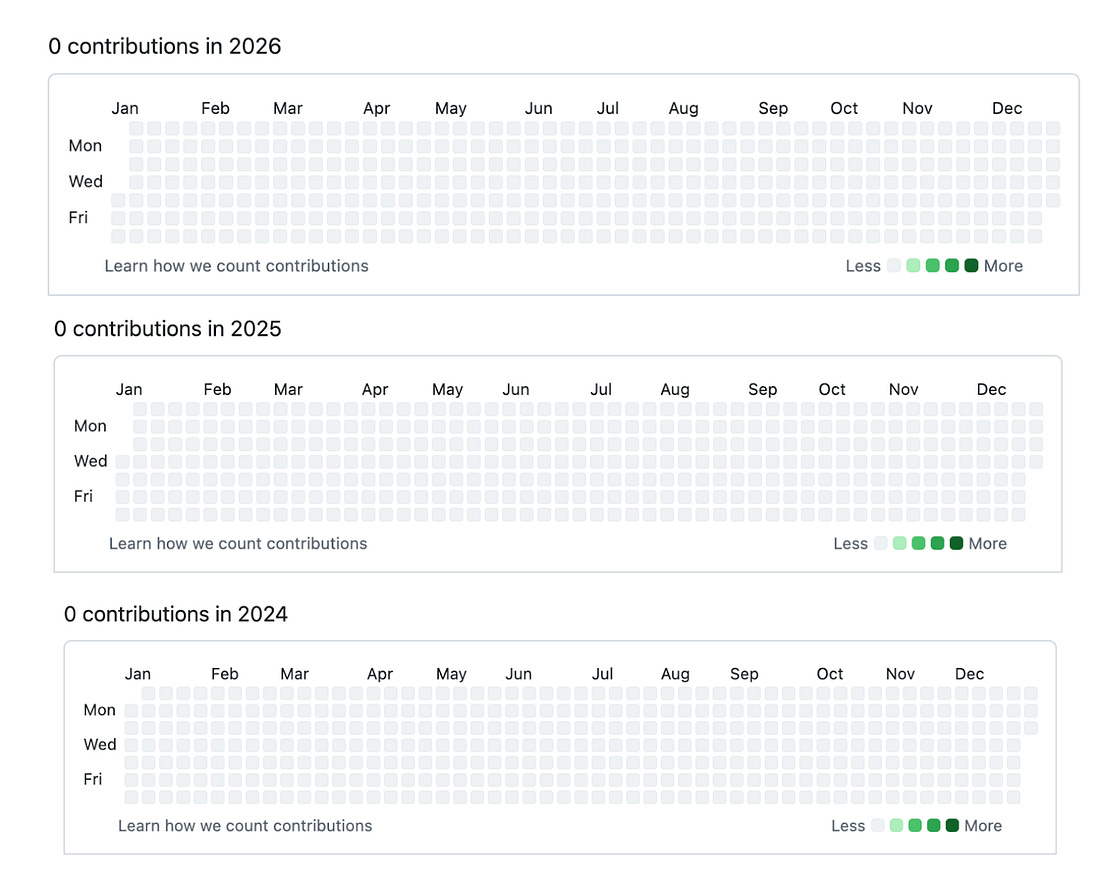
This is Sam’s GitHub contributions for the last several years: absolutely nothing.
One of the most upvoted comments on my post was by cloud technologist Olivier Frolovs, who requested an article on Sam for others to learn how he operates. Now, Sam has generously agreed to an interview and has asked to remain anonymous, hence the nom de plume (pseudonym). He doesn’t seek public attention and has a strong professional reputation. During our chat, he offered pointers for engineers looking to excel, and also as proof that an empty GitHub profile and zero social media presence don’t mean you can’t be a truly standout developer. I also interviewed one of his former managers from Uber for that perspective. Today, we cover:
BackgroundIn this article, my questions are in italic and Sam’s voice is in normal text. Sam, how did you get into tech? I was always intrigued by computers, software, and – as it came around – the internet. My dad had a black-and-white screen laptop for work with Windows 3.1 and some games. We got our first personal computer with Windows 95 and I remember it vividly. I started developing websites for my primary school and the company my mom worked at when I was 12. I got paid a small sum, so that was my first-ever paid programming project! Around then, I taught myself Visual Basic 6 and started building 2D and 3D mini-games. I found the website DirectXVB (which is still live today), emailed the website’s owner with issues I ran into, and they helped me with pointers. Later, I taught myself PHP and built more dynamic websites. From the age of 14, I stopped all coding – I just got tired of it! – and focused on my studies, and getting into college. I chose a non-computer science major for university, but picked up coding on the side, and I rediscovered that spark, so, in the first year of my Master’s, I decided to switch and do a Computer Science Bachelor’s. It was during college that I started to build apps and websites, and it’s when I got truly hooked on software development. From agency, to large company, then UberI joined an agency as their first hire, building apps for local companies. It was a small team, we learned with trial-and-error, and getting done at 2-3 o’clock in the morning was common enough. I stayed 18 months and learned a lot about ownership, the importance of an eye for detail, and collaborating with others. My favorite part of the job was the few times I worked directly with a designer: our agency employed freelance designers who were not involved in most of the projects because the company was trying to save money by having them work less, and not be involved in planning and rollouts. But during the implementation phase, I’d find myself talking with the designer and bouncing implementation and design ideas around. I then joined a small startup where we built our own product. A highlight was having two designers on the team fulltime, whom I could work with and learn from. Engineering also felt like a level up: everyone cared about software quality and UX details. Our startup got acquired by a larger company and most of us moved to the Bay Area. We stayed together as a team and were told we would maintain a “startup culture.” The founders tried their best to stay true to their word, but they couldn’t shield us from the reality of working in a corporation. I learned a lot about corporate processes, and it was more interesting than I’d expected. As I was getting closer to the senior engineer level, I had to understand how internal politics worked, how to “massage” peer teams to help support our proposals, and how to talk with engineering leaders like senior managers and directors. Our company was also hugely focused on the annual company event: it was eye-opening for me to see just how much effort went into preparation. It consisted of several rehearsals and dedicated engineering work to showcase our stuff in a way that was near-flawless on the day. After a few years, I felt ready for a change and joined Uber. I took a “title cut,” something akin to the “seniority rollercoaster.” At Uber, I worked in a new area and got promoted several times. After Uber, I worked at another Big Tech, and now – very recently – I’ve begun at a startup. 1. Getting things doneFeedback at Uber about you during performance calibrations was that you’re excellent at getting things done. What’s your process? When I started out as a junior dev, I pulled long hours so I could deliver on time – regardless of how much effort it took. I don’t know what it was, but I always felt that failing to deliver on time was never an option. I still vividly remember one project where I worked incredibly hard but still failed to deliver with the quality I expected from myself. As embarrassing as it is, I was so exhausted that I almost started crying on the spot. One of my coworkers comforted me and told me:
They were right, of course. Still, I’m pretty sure this inner pressure to be unsatisfied with “good enough” explains a lot about how I work. Having a high-level breakdown of the work, and communicating to stakeholders has been my “secret”, later in my career. After a few years as a dev, my estimation skills got better and I had to pull fewer late nights. I also found a hack that greatly helped was doing a high-level breakdown as early as possible, in all cases. As soon as I understand what the work is, I break it all down, ideally on a whiteboard or paper. Importance of communicationYou were also seen as a strong communicator, whether it was with engineers, engineering managers, or product managers. How do you get your point across? Communicating delays as “tradeoffs” works extremely well. As soon as I start a project which I’m the lead on, I establish communication channels with key stakeholders: product managers, my engineering leadership, and business stakeholders, via email or Slack, I keep them in the loop at least weekly, and about anything that could be a roadblock. In my experience, delays are not an issue as long as they are communicated upfront with an explanation and potential alternatives. When we hit a roadblock that slows down our work, I would never communicate that we’re “behind”. I would offer alternatives like:
The trick, I’ve found, is to make it clear to stakeholders that we have a choice: choose more features to ship, or choose a lower-priority feature to drop. I learned most of my hacks from people who are good at getting things done, and they have a few attributes:
Being good at communication means you have a solid foundation, and then develop a feel for how to best utilize the tools you have. There’s no “one-size-fits-all” approach: people react better or worse to different things. Try to get to know folks around you and put yourself in their shoes. Doing great workWhat does “standout” work look like to you? I think about the quality of my work similarly to the quality of work I do at home. I have moved houses and renovated them several times and I greatly care about the quality of that work. And I’ve seen plenty of contractors come to my place, perform their work, and then leave without actually caring about the quality. They just want to “get s*** done” and be out of there. I never understood how someone can keep doing their job without feeling a lot of love for it! I need to get energy from everything I do, not just in my job. Whether it’s playing games with my kids, helping my wife with her website, or building a new website feature for the company I work for: I approach it all with the same attitude. Equally, if I no longer get energy from the work I do, then I basically stop enjoying it and this can be a nudge to start to look for something else. If it continues for a long time, this urge can become more persistent, and that’s the point when I have switched companies or teams. I can go on for some time without getting energy from my work, but it drains me. I try to catch myself before it gets too bad, and I’ve managed to do so, up to now. This is why I quit my last job without having anything lined up: I stopped getting energy from it for many months and talked with my management chain about it, but they were unable and unwilling to change anything. I needed a change, so it was me who made it. Stepping outside of domain expertiseYou frequently went outside of your domain, working with engineering teams on other platforms and contributing to codebases you’re not expert in. You seemed to have a great relationship with most engineers, in contrast to some devs. How did you do this? I am pretty curious and prefer to talk directly with engineers. So, when I’d work on a project with engineers on a different stack, I would ask them to explain their high-level architecture approaches, and roll up my sleeves to make small code changes in a stack I was unfamiliar with. Once you understand the high-level structure of a different codebase, and you also know how to make a few small changes, suddenly, it’s so much easier to figure things out on your own! An approach that consistently worked for me is approaching problems from the customer’s perspective, and being genuinely curious. For example, I might ping an engineer working on a different system and ask:
By making it clear that my goal is to solve a customer problem, I’m not coming across as just digging around for nothing. And by making it clear that I’d like to learn from them, it avoids being seen as someone trying to confirm what they are doing, which could come across as arrogant – especially when the other engineer is the expert on their own system. I’ve found fellow engineers are happy to explain their understanding and decisions. 2. Setting boundariesAt Uber, I recall you were very good at setting boundaries and saying “no.” How do you do that? Honestly, I find it tough to say no – but I learned that it’s worse when I don’t. I found that saying ‘yes’ to everything usually results in an unmanageable, unbalanced pile of work. Prioritizing is key: I always remind myself to focus on what matters most. For me, the “most important” thing for any given topic could be:
Family is very important to me. When I worked at Uber, I had a reasonably long commute to the office. I blocked out my calendar so I could leave on time in order to be home for dinner with my family. This did not mean I stopped work immediately; I would sometimes work during my commute and, when necessary, I logged back on to continue working after my kids were in bed. When we had important deadline agreements at work, I made an agreement with my partner that I stayed longer in the office because I knew it was important to put in extra effort and deliver standout work then. It goes back to prioritizing and focusing on the most important thing. Looking back, I’d say most of the time, the most important thing for me was family, and that work overrode this every now and then. My approach to prioritizing keeps changing, though. Demands at home keep changing and expectations at work also change; after Uber, other jobs increasingly focused on async and remote work. This meant more flexibility to accommodate family time – but work could spill over into evening hours if I did not finish everything. If I can give one piece of advice, it’s to understand what is important for you. Know your number one, number two, number three priorities: and arrange your workday so you do your top priorities. Don’t compromise on the most important one! 3. Office politicsAt work, how plugged in were you to office politics? I was aware of politics and tried to build relationships with “influential” people. I try to stay away from “cocky” types, and to find what I want to achieve through different folks. The importance of politics is something I really started to understand when working at Uber. Initially, I was ignorant, but the more experience I got in Big Tech, the more it became obvious. It took a while before I was able to participate in it. I never liked it; I tend to be direct and transparent, but that does not work in every situation. Did you take part in it to get stuff done? Yes, sometimes by being direct and transparent, and communicating the right amount of information, you can get a lot done. Occasionally, it required me to “massage” an idea on multiple people before going to the person who called the shots. What is your view of engineers who are seen as“political”? It’s part of the game and sometimes it’s useful to have a good relationship with those people, as you can use that for your own benefit, as well. I personally would never invest much time in understanding and practising politics, as I prefer to focus on building and product. 4. Negotiation & conflictNegotiating with teamsYou were perceived as being good with other teams, and at removing roadblocks for your own. How did you approach this?... Subscribe to The Pragmatic Engineer to unlock the rest.Become a paying subscriber of The Pragmatic Engineer to get access to this post and other subscriber-only content. A subscription gets you:
|




Comments
Post a Comment