Does GitHub still merit “top git platform for AI-native development” status?
Does GitHub still merit “top git platform for AI-native development” status?Availability has dropped to one nine (~90% – !!), partly due to not being able to handle increased traffic from AI coding agents. There’s also no CEO and an apparent lack of direction.
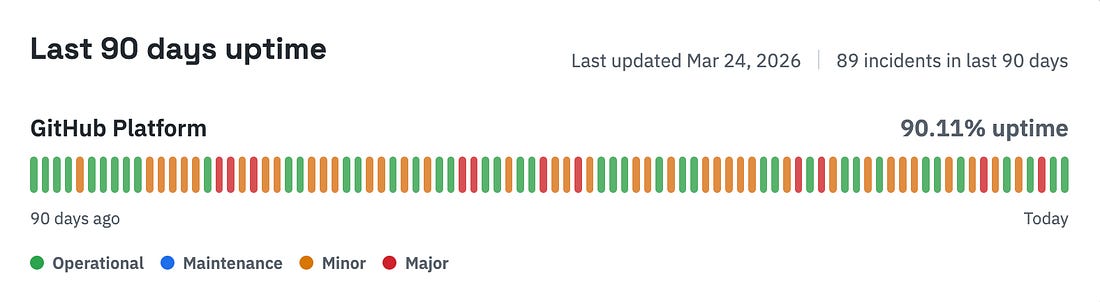
Hi, this is Gergely with a bonus, free issue of the Pragmatic Engineer Newsletter. In every issue, I cover Big Tech and startups through the lens of senior engineers and engineering leaders. Today, we cover one out of four topics from last week’s The Pulse issue. Full subscribers received the article below eight days ago. If you’ve been forwarded this email, you can subscribe here. We’re used to highly reliable systems which target four-nines of availability (99.99%, meaning about 52 minutes of downtime per year), and for it to be embarrassing to barely hit three nines (around 9 hours of downtime per year.) And yet, in the past month, GitHub’s reliability is down to one nine! Here’s data from the third-party, “missing GitHub status page”, which was built after GitHub stopped updating its own status page due to terrible availability. Recently, things have looked poor:
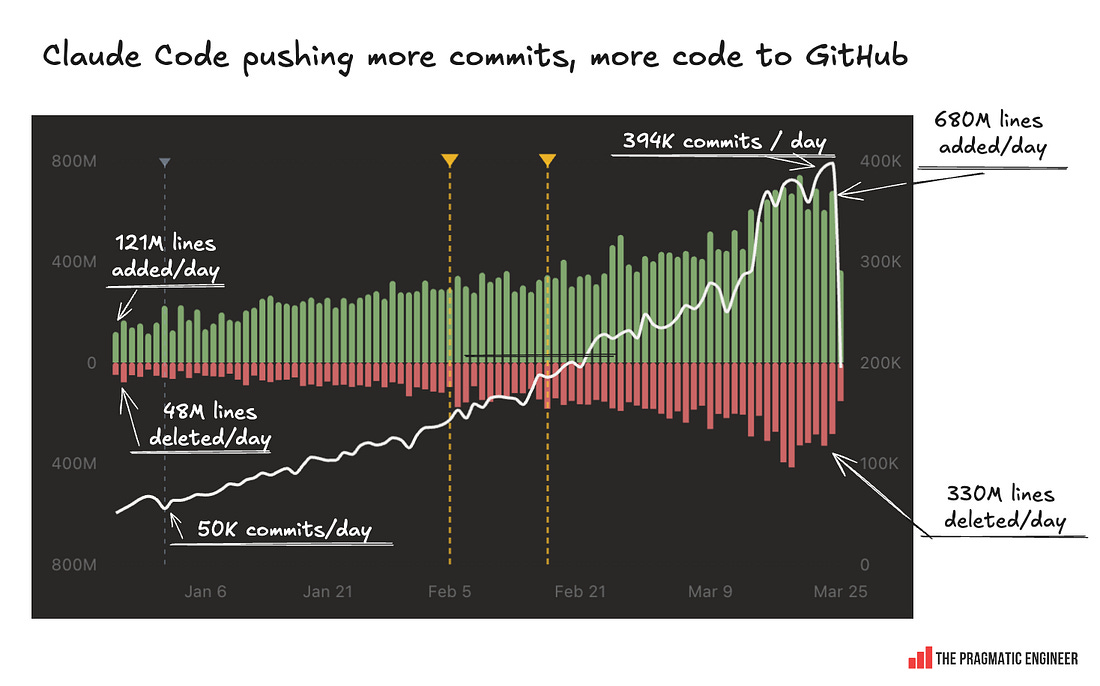
This means that for every 30 days, GitHub had issues on 3 days, or issues/degradations for 2.5 hours daily (around 10% of the time.) GitHub seems unable to keep up with the massive increase in infra load from agents. One software engineer built a clever website called “Claude’s Code” that tracks Claude Code bot contributions across GitHub. Growth in the past three months has been enormous:
Stream of GitHub outages from infra overloadGitHub’s CTO, Vladimir Fedorov, addressed availability issues in a blog post and covered three major incidents:
Software engineer Lori Hochstein did a helpful analysis of these outages and the CTO’s response, and has interesting observations:
It is certainly nice to get details from GitHub on these outages. It feels to me that infra strains are causing more infra issues → they trigger constraints faster → failovers are not as smooth as they should be. Could it be because GitHub keeps changing their existing systems? Startup shows GitHub how it’s doneWhile GitHub struggles to keep up with the increase in load from AI agents generating more code and pull requests, a new startup called Pierre Computer claims to have built an “AI-native” solution for AI agents pushing code, which scales far beyond what GitHub can do. Pierre was founded by Jacob Thornton: formerly an engineer at Coinbase, Medium, and Twitter, and also the creator of the once-very popular Bootstrap CSS library. Here’s what Pierre supports, which GitHub does not:
These are incredible numbers – if also self-reported – and something that GitHub clearly cannot get close to, at least not today! There are few details about customers, while the product – called Code.storage – seems to be in closed beta. Still, this is the type of “git for AI agents” that GitHub has failed to build, and the type of infrastructure it needs badly. Has GitHub lost focus and purpose?GitHub’s reliability issues are acute enough that, if it keeps up, teams will start giving alternatives like small startups such as Pierre a try, or perhaps even consider self-hosting Git. But how did the largest Git host in the world neglect its customers, and fail to prepare its infra for an increase in code commits and pull requests? Mitchell Hashimoto, founder of Ghostty, and a heavy user of GitHub himself, had advice on what he would do if he was in charge of GitHub, after growing frustrated with the state of its core offering. He writes (emphasis mine)
My sense is that GitHub has three concurrent problems:
I agree with Mitchell: GitHub has no “North Star” and we see a large org being dysfunctional. That lack of vision – and CEO – is hitting hard:
It’s easy to win a market when you do one thing better than anyone else in the world. Right now, GitHub is doing too many things and doing a subpar job with Copilot, its platform, and AI infra. Read the full issue of last week’s The Pulse, or check out this week’s The Pulse. Catch up with recent The Pragmatic Engineer issues:
You’re on the free list for The Pragmatic Engineer. For the full experience, become a paying subscriber. Many readers expense this newsletter within their company’s training/learning/development budget. If you have such a budget, here’s an email you could send to your manager. This post is public, so feel free to share and forward it. If you enjoyed this post, you might enjoy my book, The Software Engineer's Guidebook: navigating senior, tech lead, staff and principal positions at tech companies and startups.
|




Comments
Post a Comment