The impact of AI on software engineers in 2026: key trends

👋 Hi, this is Gergely with a subscriber-only issue of the Pragmatic Engineer Newsletter. In every issue, I cover challenges at Big Tech and startups through the lens of engineering managers and senior engineers. If you’ve been forwarded this email, you can subscribe here. The impact of AI on software engineers in 2026: key trendsOur AI tooling survey finds concerns about mounting AI costs, more engineers hitting usage limits, and AI tools having uneven effects upon different types of engineers
Recently, we ran a survey asking readers of The Pragmatic Engineer how you use AI tools, which tools you use, what does and doesn’t work, and what it’s like working with AI, in general. For today’s issue, we’ve dug into your 900+ responses to look for trends in AI tool usage among software engineers and engineering leaders. This article surfaces insights that are less about specific tools, and more about the effect these tools have on tech professionals. We cover:
We previously published a detailed summary of the survey which focused on AI tooling for software engineers, covering the most-used AI tools, trends, AI agent usage, company size and usage, and tools that engineers love. 1. CostsConcern about the cost of AI tools is a trend throughout the survey, with around 15% of respondents mentioning it in some way. Tech companies foot the bill for the majority of spending on AI tools. More respondents say their employers pay for AI coding tools than those who say they pay themselves, and predictably, employers fund more expensive packages than what individuals buy personally. Companies commonly pay for “max” plans with the likes of Claude Code, Cursor, and Codex (around $100-200/month per engineer), although some companies’ budgets only stretch to $20/month per engineer – around the price point of GitHub Copilot, and the cheapest Claude or ChatGPT subscriptions. The most-mentioned AI tool spending patterns:
For now, companies seem to be in the experimentation phase with AI tools, and several respondents say that they believe their companies have unsustainable AI-tooling budgets. This is likely because businesses are figuring out the best way of leveraging the tools, and the message to engineers at such places is to not worry about price and usage while that unfolds. A CTO at a small, US-based company shares:
Breaking the budgetAt small and mid-sized companies, leadership teams seem more comfortable about going over budget, than engineers running out of budget. There are more accounts from C-level folks and founders about racking up large bills than there are from engineers. A CPTO (Chief Product and Technology Officer) at a mid-sized company:
Top spenders can be allocated higher budgets. A number of tech businesses have separate, larger budgets for their heaviest AI users. A senior C++ engineer working in the video game industry says:
UK and EU companies worry more about budgets than US-based ones. Most responses which mention finance teams pushing back against spending even $30-50/month per engineer on AI tools are based in the UK and EU. One amusing example is a 10-person, seed-stage startup where the CEO questioned why they were paying as much as £25/month per engineer for one of the cheapest AI tools around. In general, it feels like European companies want to see clear value-add in order to justify an increase in tooling spend, whereas US companies are more comfortable with investing first and measuring impact later. At present, the impact of these tools is hard to quantify. A niche approach is that of AI teams educating devs to use cheaper models. Some European companies go as far as offering education to new joiners on using cheaper models. From an AI Enablement Lead at a 1,000+ person, digital transformation company:
Cost trajectory worriesThe cost trajectory of AI tools is generally considered unsustainable in our survey. Devs using the tools heavily tend to hit usage limits, and their employers then have to pay more. At places with API-based pricing, usage is increasing. Those in leadership positions who are responsible for budgets are generally concerned about the direction of costs. Subsidies are keeping things at bay – for now. A common enough pattern in our survey is of heavily-subsidized enterprise plans that come with vendor lock-in. Several responses raise concerns about what will happen when the subsidies run dry. Experienced engineering leaders recall that cloud providers also played the same game of subsidizing for a few years, then raising prices when a customer was fully “locked in.” The AI hype cycle is dampening awkward conversations about budgets at some places. A principal engineer at a Fintech tells us:
But some finance teams are getting grumpy. A CTO at a sports-tech company says:
Most survey respondents think the price of AI tools will have to rise. If that happens, it would cause problems at several companies – particularly those in Europe:
2. Usage limitsAnother major trend in our survey results is the topic of usage limits:
Why users of AI tools hit limitsCommon reasons cited in the survey: Being a new AI user or a power user. These are two distinct groups, but an engineering manager at a mid-sized company in Canada says that each one similarly blows through token limits for different reasons:
Using Opus for all work. A few engineers mention being careful about how they use Opus because it previously ate up their token budgets. Here’s a software engineer at a mid-sized company in Europe:
Mistakes that eat up tokens are easy to make. These include starting on work or a problem from the wrong end, using AI directly for a task rather than opting for a simple script, trying some new tool or technique that ends up consuming tokens (OpenClaw and Ralph Loops are cited), and others. What happens when the limit is hit?Hitting the limit with an AI tool is inconvenient and happens to many developers, who take a variety of next steps: Switch the model or tool. Around a quarter of respondents who hit limits mentioned switching. From a software engineer at working at Atlassian:
Upgrade to a pricier plan. When it’s an option, this is a no-brainer at most places, especially as the alternative would be devs twiddling their thumbs waiting for the limit to be reset. A senior engineering manager at a mid-sized company says:
Adopt API-based pricing. This is the easiest way to keep working without abandoning a task you’re knees-deep in. A senior engineer at a large company says:
3. Impact on “builders”We identified three different types of professional in the survey:
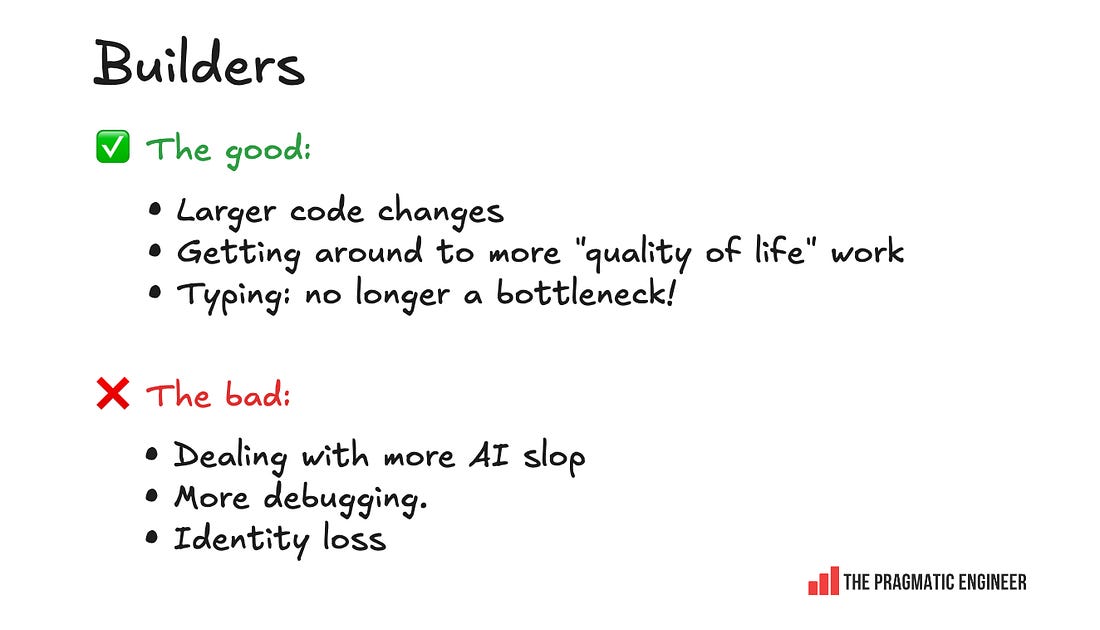
The overall consensus in our survey results is that AI will amplify and multiply tendencies and patterns that existed before, and the impact of the tools varies accordingly among users. Let’s start with the impact we’ve observed upon builders in the responses:
Builders say they get value from AI tools in the following areas: Larger code changes. Builders generally find AI helpful for work like:
All these are changes that are laborious, but not very challenging technically. They also require experience in knowing what you want to do and how to do it. Accomplishing “quality of life” tasks. Builders mention that with AI tools, they get to fix and improve things like nagging bugs that otherwise wouldn’t be “worth it” in time invested, but the barrier to entry is lower with AI. A good example of this is in last week’s podcast with David Heinemeier Hansson (DHH), the creator of Ruby on Rails, in which he revealed how one of their engineers optimized P1 – the fastest 1% of web requests:
Typing is no longer a bottleneck. Some builders report falling even more in love with coding with the help of AI and agents, since physically typing out code is no longer a bottleneck for them. They enjoy being able to prompt. From one “builder”:
The negative sides of AI tools, as experienced by builders:
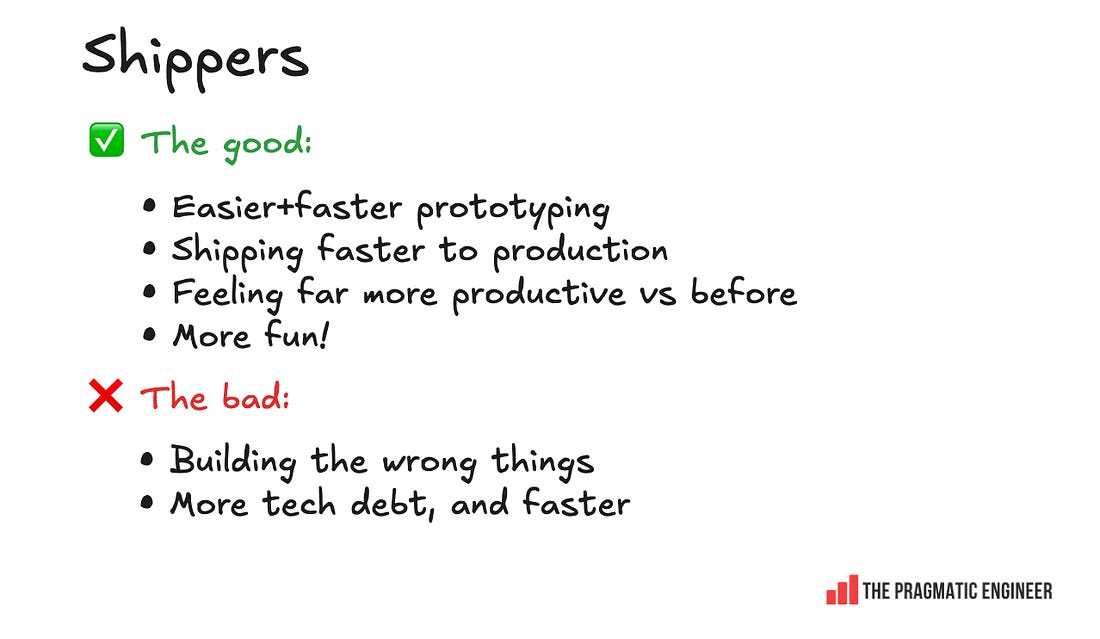
4. AI tools speed up “Shippers”The “shipper” archetype thrives when they get things to production quickly. This group is by far the most enthusiastic about AI tools in survey responses. They are also the ones who praise – or hype up – the tools because of their personal experiences of shipping much faster with them.
The biggest upsides mentioned by shippers:... Subscribe to The Pragmatic Engineer to unlock the rest.Become a paying subscriber of The Pragmatic Engineer to get access to this post and other subscriber-only content. A subscription gets you:
|




Comments
Post a Comment