What is “loop engineering?”

👋 Hi, this is Gergely with a subscriber-only issue of the Pragmatic Engineer Newsletter. In every issue, I cover challenges at Big Tech and startups through the lens of engineering managers and senior engineers. If you’ve been forwarded this email, you can subscribe here. What is “loop engineering?”There’s talk about loop engineering, but what is it exactly? I looked into it, and found triggers, cron jobs, AI slop & more. Is it a “here today, gone tomorrow” trend?
“Loop engineering” has become a trending topic in the past month, after some high-profile folks at Anthropic and OpenAI revealed that they have stopped writing prompts, and started designing loops. At Anthropic’s developer conference, Boris Cherny, creator of Claude Code, said (emphasis mine):
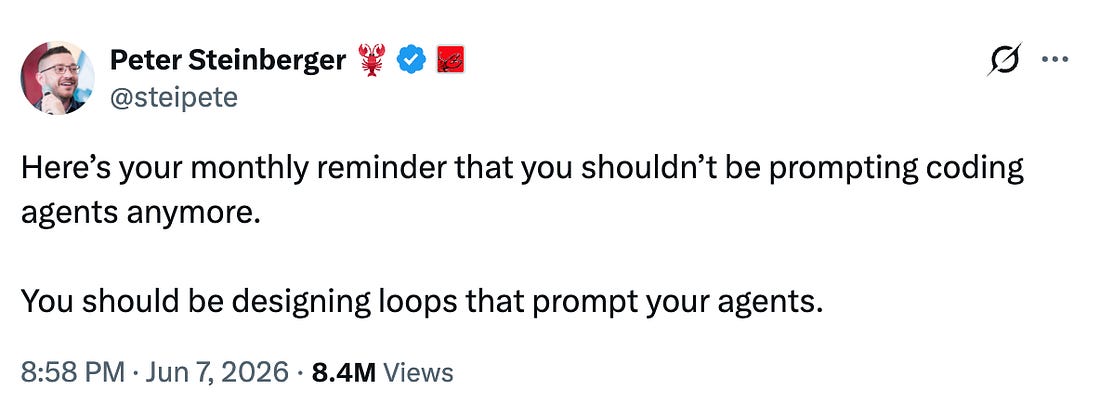
Soon after, Peter Steinberger, creator of OpenClaw, preached loop design in a post:
Elsewhere, Addy Osmani, formerly of Google, wrote an article, ‘Loop Engineering’:
That’s three mentions in quick succession of this new approach, which is a novel one and therefore pretty abstract to me. To find out more, I turned online to some of the folks who read these articles. In replies, you told me what “loop engineering” means to you and gave some examples of loops in your work. Today, we cover:
1. Where it began: “Ralph Wiggum” loopExactly a year ago, software engineer Geoffrey Huntley published the article ‘Ralph Wiggum as a software engineer’. The name references the naive son of the local police chief in The Simpsons, who is extremely eager to always be helpful. In engineering, “Ralph” is intended to continuously nudge the agent in the right direction. Geoff described it:
The article expands on the idea of the Ralph loop:
Geoff published the experiments he did with this approach, such as building a new programming language last summer, and said it requires skill:
The “Ralph method” blew up late last year with the arrival of better models which were surprisingly capable of building ambitious projects. Software engineer Matt Pocock created a tutorial, ‘Ship working code while you sleep’ with the Ralph Wiggum technique. He said:
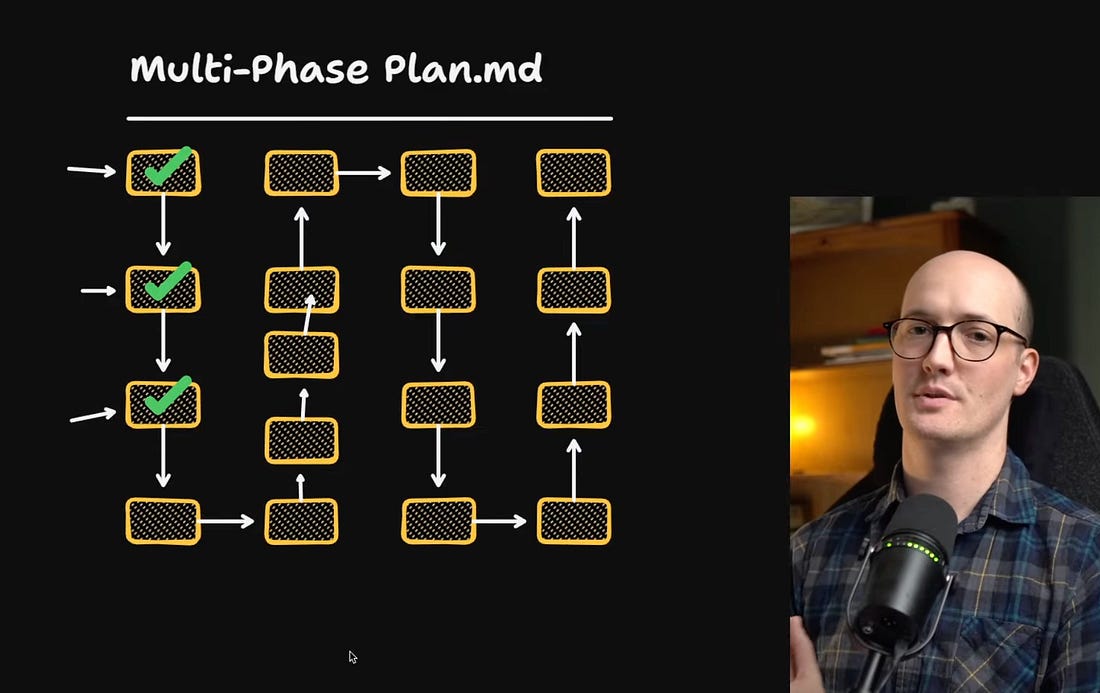
Before the Ralph loop, Matt did this in two steps:
A problem with this approach is there’s no easy way to add new tasks to the “masterplan”. Software engineers know that most plans do need to be modified, often while the work is ongoing. In contrast, with Matt’s take on the Ralph method, the “masterplan” is continuously updated in a “master PRD”. Here’s the prompt he gives the agent:
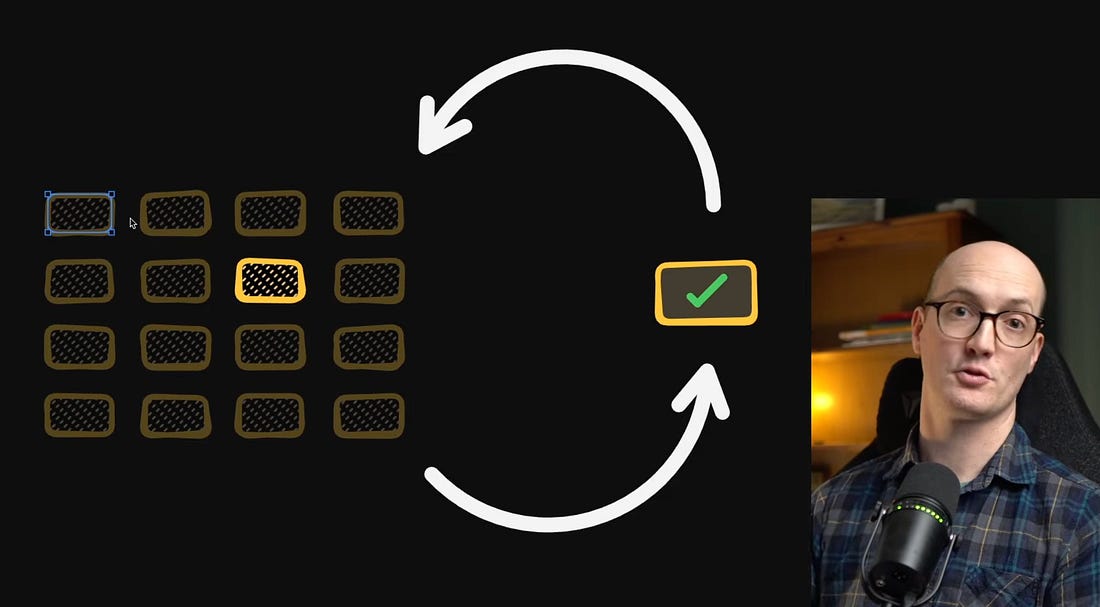
This style of working is more of a “dynamic Kanban”:
The “Ralph method” is all about working around context window limitations. Back in mid-2025, the maximum size of a context window was around 200,000 tokens. That’s not enough for more ambitious tasks, so it’s necessary to break up agent runs into smaller ones and run them, one by one. In this context, here’s where the Ralph method works:
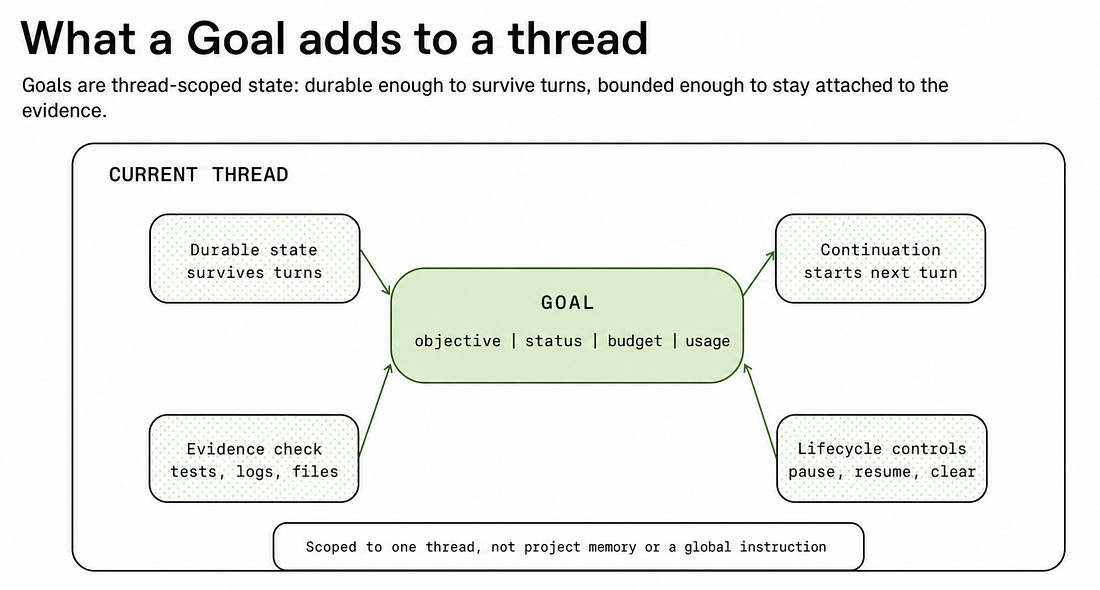
2. The /goal command ships in all major harnessesFor a few months, building a Ralph loop meant doing it yourself: setting up the loop, state tracking, deciding how the agent can add tasks and when to stop. But things changed once coding harnesses made it easy to run these loops. April: Codex ships /GoalsAbout six months after the “Ralph technique” started gaining wider traction, Codex shipped the “Goals” feature in Codex. From the documentation:
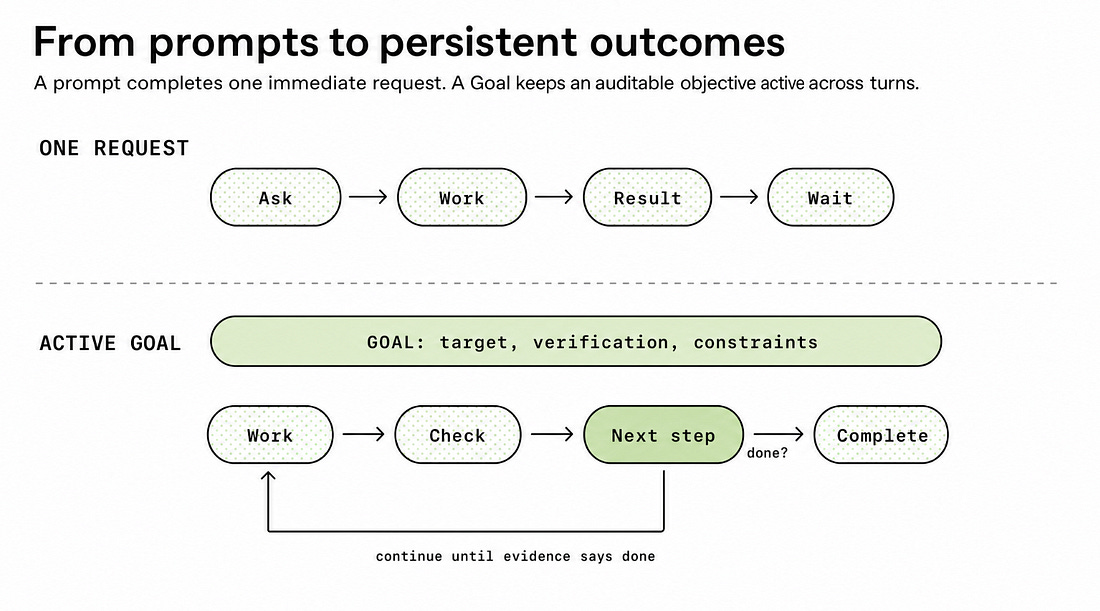
Also from the docs (emphasis mine):
A visual representation:
Here’s an example of using a goal in Codex:
That’s a clear enough “end criteria” to just hand off to the agent, which then breaks up the task, spawns subagents, and runs until complete. So, how did OpenAI build Goals? They used files, logs, running tests, and lifecycle controls:
In this way, “Goals” feels awfully similar to a Ralph loop, except compressed into a single command! It feels like the Codex team took the idea of the Ralph loop, built infrastructure around it, took care of coordinating agents by not having them step on one another, dealt with state, running of tests, starting and stopping agents, and then added functionality such as being able to set a budget. May: Hermes and Claude Code follow with /goalThree days later (May 2), Hermes agent, a popular AI agent framework and OpenClaw rival, shipped their implementation of /goal. From the docs:
Less than two weeks later – on 12 May – Claude Code also shipped their /goal command. It’s identical in what it does to Codex. From Claude Code:
A few months before, in March, Claude Code shipped the concept of scheduling an agent with the /loop command. It is basically what JavaScript’s setTimeout() function would be equivalent to: repeat a task after a given interval until the work is done. By May, running a Ralph loop had become as simple as giving a single command in one of the major agent harnesses. It’s as if AI labs noticed user demand to do more with agentic loops which were hard to set up, and built ways to make it simpler. For instance, in open source agent harnesses like OpenCode, there are plugins like the /goal plugin. For the minimalist coding agent, Pi, the /goal command can be added as a package. 3. Loops which devs use: triggers and cron jobsBy May, we had access to the /goal primitive. So, what use cases were Boris Cherny and Peter Steinberger referring to in terms of spending most of their time on designing loops, instead of writing prompts? I asked around for examples of “loop engineering” from fellow devs. Based on ~210 replies, mostly from X and LinkedIn, it seems that triggers and cron jobs are two very common use cases for loop engineering: Triggers / automations: an agent kicks off when an event happens. The event could be an error being logged, a new ticket created, customer support feedback received, etc. Pre-AI, these events were typically triggered by a webhook, and kicked off things like a Slack bot posting in a channel, triggering a system, or being the starting point of a Zapier or an n8n integration. Cron jobs: many devs see “loop engineering” as kicking off jobs that involve agents on a cadence. This is fundamentally the same as scheduled cron jobs. From director of engineering, Oded Messer:
4. Helpful loops for devsBelow are some workflows with AI agents that run on a regular basis as a /loop command, or when triggered: Development-related workOpen PRs for newly recorded app issues. Software engineer Ivan Pantić:
Fix flakey tests. Paul D’Ambra, software engineer at PostHog:
Triaging issues and outages. Software engineer Ivan Abad:
Review design plans. Artem Nikitin, software engineer at Elastic:
Daily/nightly workDaily product improvements. Jack D, founding engineer at Schematic:
Nightly end-to-end test run babysitted by an agent. Utku K, engineering manager:
More complex development workBuild new telemetry integrations and verify they work. Lawrence Jones, software engineer at Incident.io:
Do a long-running migration, mostly autonomously. Startup founder Rafel Mendiola:
Productivity-related workflowsDaily tasks executed. Aaron Stannard, creator of Akka.NET:... Subscribe to The Pragmatic Engineer to unlock the rest.Become a paying subscriber of The Pragmatic Engineer to get access to this post and other subscriber-only content. A subscription gets you:
|




Comments
Post a Comment