Headed for the Exit: the Great Engineering Leader Career Break

👋 Hi, this is Gergely with a subscriber-only issue of the Pragmatic Engineer Newsletter. In every issue, I cover challenges at Big Tech and startups through the lens of engineering managers and senior engineers. If you’ve been forwarded this email, you can subscribe here. Headed for the Exit: the Great Engineering Leader Career BreakTrend: more CTOs, VPEs, and Heads of Engineering are walking away from their high-status, in-demand positions. There are many reasons, mostly related to AI, and to "founder mode"
In my ~20 years in this industry, I’ve not seen as many capable engineering leaders opting out or taking prolonged breaks as now, with some high-ranking engineering leaders – CTOs, VPs of Engineering, heads of engineering, etc. – quitting their high-status roles and departing, if not into the sunset, then at least with nothing lined up. To find out what might be behind this spate of sign-outs, I talked with almost 20 engineering leaders currently on a career break – or seriously considering one – and they let me into their personal reasons for deciding to jam the brakes on their careers. Thanks to everyone who shared their input! Today, we cover:
The bottom of this article could be cut off in some email clients. Read the full article uninterrupted, online. “Just me?”I was recently messaged by a head of engineering in San Francisco, who said:
I asked around privately, and it turns out a majority of the CTO-level folks I spoke to are considering the very same thing, or are actually in the process of leaving the office for a long spell away; 6/10 engineering leaders said they’re on the way out. 1. The job got (much) worseUnrealistic expectations, including about AI, by founders and CEOs are the leading cause of jobs turning bad for CTOs and VPEs right now in 2026:
Hands-on founders with “AI psychosis” make the job predictably harder, according to one CTO who just signed out of his job:
Founder slop issues begin when top leaders get excited about AI’s capability, then get hands-on and start issuing PRs, and shipping code to production. It can cause issues across the board:
Another way that leadership roles have diminished is that craft and quality are less important, says a VP of engineering who’s in the process of signing out of their job:
Things also go bad when companies don’t ‘get’ AI+engineering, except as a way to cut jobs. CTOs I talked to mentioned the likes of Ramp, Stripe, and Notion as places that understand how to integrate AI into the engineering culture with a growth mindset without forsaking quality. Elsewhere, bad vibes dominate at places where going all-in on AI leads to the cynical conclusion that product management, design, and engineering leadership are irrelevant. 2. The startup is “losing” and becoming worthlessDirector+ roles have a few differences from individual-contributor engineering ones:
A company that adopts AI rapidly usually falls into one of three buckets:
The majority of software startups fall into one of the first two buckets of being AI-native or under threat. Senior leaders at such companies are in a good position to evaluate whether their company is a “winner” worth staying with. Leaving due to equity becoming worthlessA CTO who quit their startup told me:
This CTO had a very generous equity grant at 2% of shares, so what made him leave it behind? They laid out how it will be difficult to get any benefit from them because the shares are most likely rendered worthless by rules about the order in which different investors get their share of the pie:
If a VC-funded company does not have the revenue or customers to grow at a fast tick (circa 20-50% per year), then it’s often a struggle to raise the next round of funding, and the business’s actual value usually shrinks to 3-5x of annual revenue. So, if a startup is making $10M per year after raising $110M in funding, and growing 30% year-on-year, then the company is likely worth around $30-50M. Perhaps the right buyer would pay $100M, but if growth slows, the value is likely to drop. An experienced CTO who takes a step back and assesses things can realize when there’s a high chance of their equity turning into smoke, removing a reason to not sign out of the job. It’s what happened to the CTO above, and when they couldn’t turn the business around, they quit. Business stops growingWhen a VC-funded startup’s business stops growing, the prognosis can be dire in the sense that it’s unlikely to be worth as much as in the previous funding round. This is true even when the startup becomes profitable: this might mean it could theoretically go on forever; but with slow or no growth, it won’t win in another VC funding round. Here’s a VP of Engineering who saw their startup stop growing, partly due to wrong bets by the CEO:
I’d add that deprioritizing reliability in favor of building features may be sensible in the early days. The problem seemed to be that this company had not found product-market fit, and the new AI features didn’t resonate with customers. Basically, the CEO lacked customer understanding, business intuition, or both. So, good on the VPE for getting out when they saw the direction of travel. If the CEO won’t accept input from the VPE – who would’ve at least prioritized reliable operation – then there isn’t much left to stick around for! 3. Not being AI-native enough for other skills to be relevantThe top-paying engineering leadership positions have one thing in common: experience of leading AI-native organisations is expected, and leaders are sought who have turned their current company AI-native, or work at such a place. It’s new to see people signing out of large companies for feeling like they’re lagging behind in adopting new AI workflows. An ex-engineering director at a large bank told me they quit their job to accelerate their career:
Consider this: if you stay in your job for two more years, do you expect to find career opportunities at cutting-edge companies in the future? If the answer is “no”, then there’s a risk in just staying put. Joining an uncertain startup or taking a career break to develop AI expertise is also risky, but the outcomes may be more controllable than letting your skillset become outdated, relatively quickly. But it might actually be necessary to quit in order to get AI experience: you might be able to get this by transferring to an IC role. As Charity Majors, co-founder and CTO of Honeycomb, said in last week’s episode of The Pragmatic Engineer podcast:
There are companies where moving from Director+ to individual contributor is possible, even if these companies are the minority. If you happen to work at a place like this: consider if you can and will take advantage of this opportunity. Most companies say they want to be AI-native, but never doClaire Vo – founder of ChatPRD and host of ‘How I AI’ podcast, and the former Chief Product & Technology Officer at LaunchDarkly – says most companies will never become “AI native” simply because most VP of Engineering or CTO folks don’t have what it takes to pull off such a transformation. In her words:
It looks like there’s a deadlock:
According to this, many VPEs and CTOs are doomed to fail at making the change they want, and it’s hard to know if that’s because organizations didn’t support them properly or resisted change. 4. Their predecessor saw the “writing on the wall”There’s (usually) a honeymoon period in a new job, when we believe in the business we’ve joined and in its direction. But when this phase passes, a fraction or all of the problems described above may emerge, and there’s a decent chance that some of them are why your predecessor signed out:
I’ve talked with a CTO who replaced their predecessor and founding CTO. A few years into the job, the predecessor CTO realized their equity in the business was worth almost nothing due to stalled growth, all while they were also being out-competed by AI-native rivals. So, the new CTO also resigned after a short, six-month tenure. 5. Long hours – rarely decisiveTwo engineering leaders – a CTO and a VP of Engineering – mentioned “insane working hours” as a factor that contributed to them finally quitting. But there were other things as well:
My sense is that at a thriving business during chaotic times like these, it’s unlikely that long hours alone would spur people to leave, if their contribution to current success counts and is valued. When things are going well, it’s possible to delegate more and take time to recharge batteries. But when things are going badly, it feels like every waking hour needs to be spent on working to turn things around. 6. Smaller teams mean less need for leadersSeveral engineering leaders are stepping back into IC roles for more stability because engineering teams are smaller now. Karthik Hariharan, engineering leader at DoorDash, notes:
Some reasons why engineering teams have shrunk: “Fullstack engineer” is mainstream, and was even before AI. Fullstack engineering was becoming relevant a few years ago in terms of a single engineer working on both the front and backends, instead of having a frontend engineer building the UI, and a backend engineer working on backend services. Fullstack frameworks like Next.js or Ruby on Rails made all this pretty easy before AI. Today with AI coding agents, you can rely on them to write decent code on platforms you’re unfamiliar with. There’s now little to no reason why a project would need multiple devs with different specializations. It’s normal for one, or a maximum of two fullstack engineers, to be working on any given project at Anthropic as well. Head of Claude Platform, Katelyn Lesse, shared how it works at Anthropic:
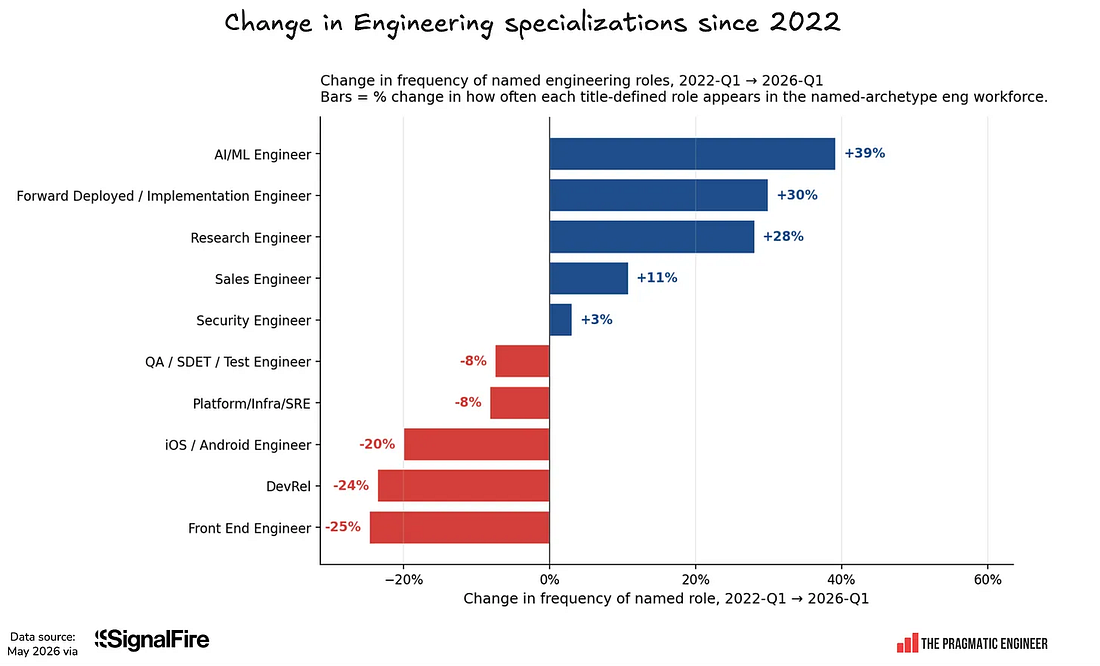
Frontend-only and native mobile teams are also getting smaller or disappearing. Even at companies where iOS and Android are a big part of the business, more places are building using cross-platform technologies where one engineer can do the work that used to need several. For example, social media app Bluesky had a single engineer build its web, iOS, and Android apps for launch by using React Native and Expo. Bluesky later hired more people to work on the web and apps, but they all work across these three platforms. It’s not the same as hiring separate web engineers, iOS engineers, and Android engineers. We cover this in more detail in the deepdives Cross-platform mobile development and Is there a drop in native iOS and Android hiring at startups? We also observed a steep drop in frontend engineers and native mobile engineers in our latest state of the tech jobs market report:
Tech companies have been flattening their org structures for three years now. We first covered the trend for fewer middle managers back in 2023, when Meta drastically reduced manager positions. The trend has not stopped, and many – if not most – companies have increased the number of reports each engineering manager has, while reducing the number of layers in their organization. 7. Fractional CTO work preferred over fulltime positions...Subscribe to The Pragmatic Engineer to unlock the rest.Become a paying subscriber of The Pragmatic Engineer to get access to this post and other subscriber-only content. A subscription gets you:
|




Comments
Post a Comment