Why has Shopify dropped React Native?

👋 Hi, this is Gergely with a subscriber-only issue of the Pragmatic Engineer Newsletter. In every issue, I cover challenges at Big Tech and startups through the lens of engineering managers and senior engineers. If you’ve been forwarded this email, you can subscribe here. Why has Shopify dropped React Native?It’s only been a year since the e-commerce platform declared it was very happy with React Native, but now Shopify is dumping it – and the reason, unsurprisingly, is AI
Before we start: given this article is about native mobile development, I want to offer my 2021 ebook, ‘Building Mobile Apps at Scale: 39 engineering challenges’, for free to all readers. (normally costs $20). The book remains relevant on the challenges to solve for large-scale mobile applications, and lists the technologies covered below in this article, Kotlin Multiplatform included. This offer is valid until Friday, 2 October. On checkout, simply select “The ebook: PDF & EPUB versions of the book.” No credit card required! Feel free to share the link with colleagues who build mobile apps, or work on them. Recently, Shopify dropped the bombshell announcement that Native is now the future of mobile development at the e-commerce platform. This triggered a lot of reaction in the mobile development community, on the scale of the stir Shopify generated when it originally moved over to React Native six years ago. But times have changed, and we all know the agent of change this time: AI agents! This latest generation of models has improved in coding capability to the extent that Shopify no longer is satisfied with React Native (RN), as it was only last year. This article looks into what led here, why Shopify made the change, and also the broader mobile ecosystem. We cover:
1. Why Shopify chose React Native in 2020Let’s rewind to 2020, when Shopify decided to go all-in on React Native (RN). Back then, mobile was a very important channel for the platform, with seven out of 10 customers using it on mobile devices. As Head of Engineering, Farhan Thawar wrote at the time:
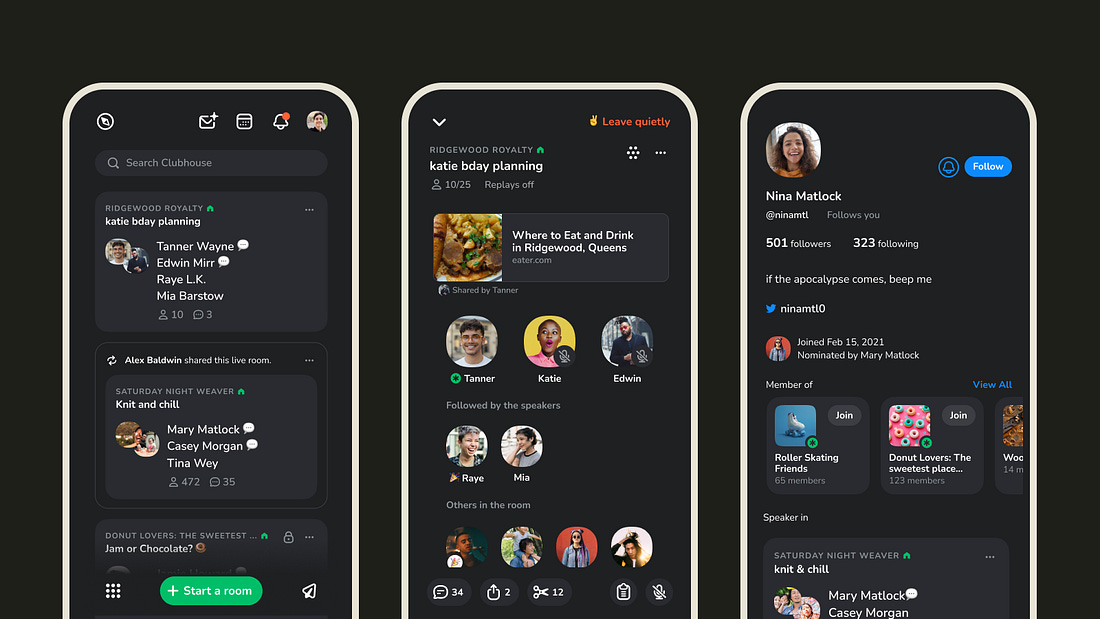
With mobile so important, it’s no surprise the company built native mobile applications for iOS and Android; after all, native mobile gives full control of a platform’s capabilities, integrations, and performance, so why bother with cross-platform technology? It turns out one reason was the delay in launching native apps on Android, which Shopify struggled with, along with other companies. When Android takes a year+ to launch: the Clubhouse failDuring the pandemic at the start of the decade, the live conversations app Clubhouse was a massive hit after launching in March 2020. The app was iOS-only for the first 14 months as the team was unable to release an Android app. And at the end of the year, usage absolutely exploded:
Despite all that popularity, Clubhouse was unavailable on Android at the time! It took 14 months to launch a beta version of Clubhouse on Android, and by the time it did in May 2021, the platform had passed its peak a few months earlier and usage numbers were by then trending down. It took until July 2021 to roll out the Android Clubhouse app globally – 16 months after the iOS version – by which time it was too late to catch the growth wave, and that spelt doom for the promising business. How did this happen? There were a few main reasons:
Building a native Android app from scratch – even with an existing iOS app as a blueprint – was a challenge during the 2010s and early 2020s. Clubhouse is an extreme case of a business which went wrong, partly due to a sluggish Android launch. But customer habits could have played a part: at the time, most US startups prioritized iOS apps and features first because in the US, the most valuable users were increasingly found on iOS. Prioritizing iOS made business sense for companies with mainly US customers, but not for ones with a global footprint, where regions like Asia featured mainly Android smartphone users. React Native helped Shopify add Android support fasterShopify’s first positive experience with React Native was in 2018 with the Shop app (then called ‘Arrive’). The company summarized (emphasis mine):
Moving over to React Native was one of the easiest ways to speed up the rollout of Android versions of new apps. In 2020, when Shopify announced the move, that was the stated intention:
2. Still happy five years laterLast year, Shopify declared it was satisfied with the move to RN in a recap article, ‘Five years of React Native’. The summary was quite the victory lap:
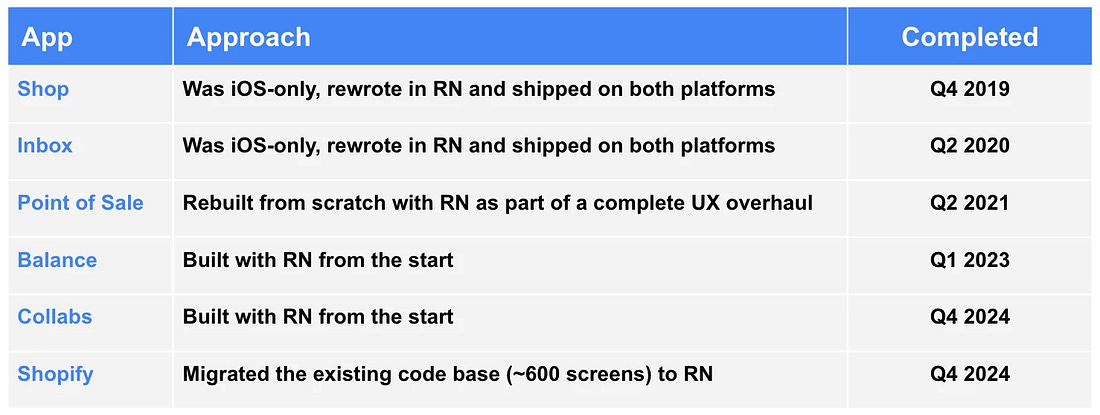
They weren’t kidding: in five years, six mobile apps were migrated to React Native:
Shopify’s engineering team said they loved a lot about React Native. Mustafa explained:
There were also some new challenges:
But how quickly things can change in tech… 3. Why ditch React Native now?There was widespread surprise this month when Shopify announced that Native is now the future of mobile at Shopify, meaning that RN is suddenly history. From Head of Mobile, Mustafa Ali (emphasis mine):
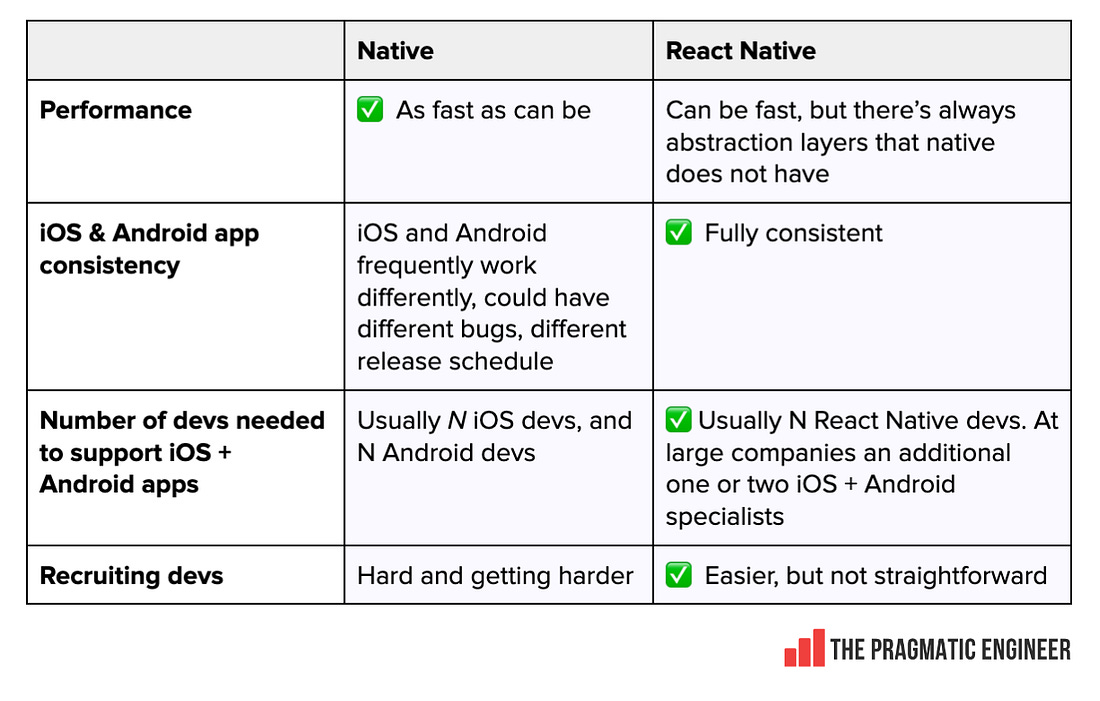
Of course, there have always been pros and cons in choosing native over cross-platform. Pre-AI, this is how it looked:
What’s changed is that AI coding agents are now much more capable at generating iOS and Android code. How React Native renders elements – a recapThere’s no doubt that fully native apps are well-built and always more efficient than those built on a cross-platform interpreter like React Native. Nonetheless, RN has come a long way to be much more performant – with one additional abstraction layer between RN code and native code – especially since the New Architecture of 2024, Let’s visualize how it works:
React Native’s core philosophy is to minimize updates done on the UI using expensive rendering operations. So, RN maintains a React Host Tree of visual elements on a screen (think a “logical tree”) which transform into a Host View Tree, the representation on iOS and Android. React itself cleverly minimizes re-rendering operations, which saves on compute resources. Why performance necessarily wins with native appsAs mentioned above, a well-written native app naturally outperforms a React Native version. The easiest way to see why this is, is to sketch what happens with native apps rendering, compared to with React Native:
React Native can theoretically be more performant, in the unlikely event the Native version has a poorly written structure, or if UIKit / Jetpack Compose or any other native library is inefficient enough for this to happen! But native has many fewer abstraction layers. One common question since Shopify moved to native is how come the Shop app had not moved over to the New Architecture to improve things like startup performance. I reached out to Head of Mobile, Mustafa Ali, about that. He told me:
The team has written in detail about the move to New Architecture. Nonetheless, being on native code provides a lot more opportunities to improve performance; after all, you can now control the complete rendering stack! Heck, you could also throw away the Apple-built system libraries like UIKit or ComposeKit and build more performant ones. Shopify doesn’t plan to go this far, but Head of Engineering, Farhan Thawar, told me they expect performance wins:
One engineer, two platforms with AIOne benefit of React Native was that it wasn’t necessary to have both an iOS engineer and an Android engineer. But with AI, one engineer can build software on both platforms, Mustafa Ali told me:
Farhan put it even more simply:
Shared codebases more trivial with AIAnother downside of going native is having two codebases to maintain, which tend to diverge from each other in behavior, features, and bugs. But with AI, Shopify doesn’t see this as a big problem any more. Mustafa:
Shopify is also building a shared verification test suite to validate the two apps as identical. Again, from Mustafa:
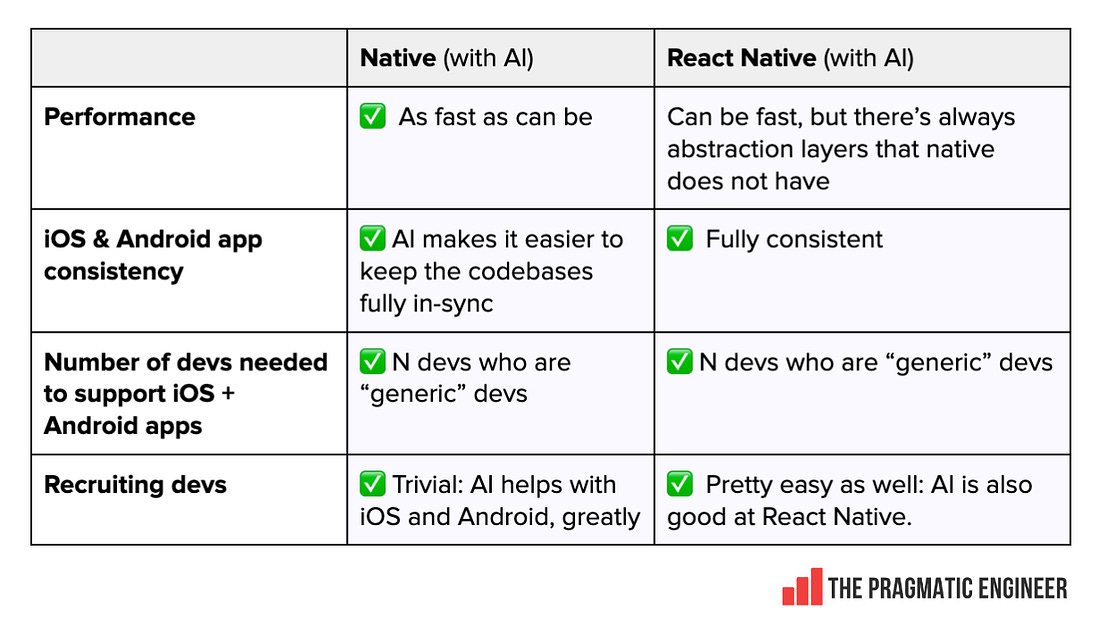
Smart! It also confirms my sense that verifying code is becoming very important for working with agents, as is building dedicated verification layers. How React Native & native compare todayLet’s return to the comparison table and update it for how native + AI changes the equation for Shopify:
My personal sense is that the downsides of native development disappear with AI tools getting so good, and that Shopify now has full control over the performance and architecture of its native apps. With the decision to go all-in on native with AI, the e-commerce business is committing to migrate all of its apps. With AI, it should be faster than the migration to React Native was. Mustafa, again:
Best of luck to the team with this migration! I’m looking forward to hearing about what they learn with this move. 4. Haven’t we seen this back-and-forth before?...Subscribe to The Pragmatic Engineer to unlock the rest.Become a paying subscriber of The Pragmatic Engineer to get access to this post and other subscriber-only content. A subscription gets you:
|






Comments
Post a Comment