The state of the tech industry in 2026

The state of the tech industry in 2026A look into what has changed, what’s still the same – and what’s broken – in the tech industry. The full video and the summary of my keynote at LDX3 New York
I recently delivered the keynote at the LDX3 engineering leadership conference in New York, attended by 2,000+ engineering leaders, CTOs, Director+ and Staff+ engineering folks, in which I attempted to create a snapshot of where the tech industry is at this exact point.
It came after I had the chance to visit the AI labs OpenAI and Anthropic, meet innovative startups like Ramp, Uber and others, get new, unpublished data from GitHub, Factory AI and Linear. Thanks to the kind access to these teams! Before the conference, I spent weeks identifying and recording trends that didn’t exist a year ago – or were much more nascent back then – and also things that are currently broken, and others that remain unchanged. Today, we cover:
You can watch the full talk, which is 29 minutes long: 
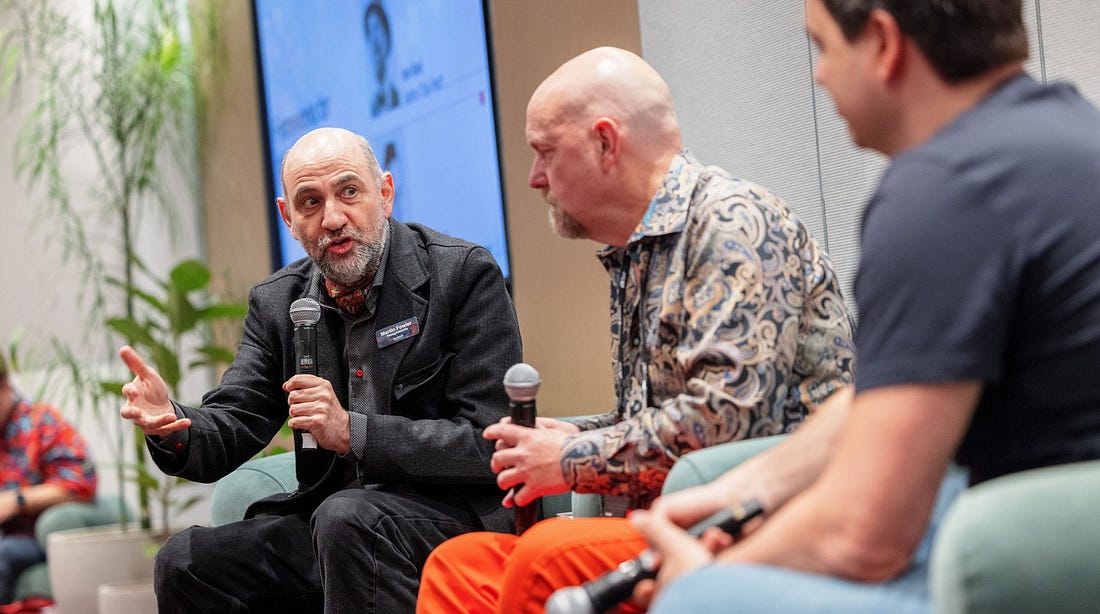
The bottom of this article could be cut off in some email clients. Read the full article uninterrupted, online. 1. Speed of changePeople in tech are more than used to change; seeing the internet go from zero to everywhere, the arrival of mobile communications and smartphones exploding in popularity, cloud computing rising from a niche concern, and the development of programming languages like Go and Rust, and frameworks like React (web) and Jetpack Compose (Android). Despite this, the scale and pace of the impact AI is having at present is still without precedent. That’s how industry veteran Martin Fowler described it at The Pragmatic Summit:
My own take is similar; we are without doubt at the beginning of a massive technological transformation, and after it, software will be built differently from how we’ve been doing for decades, although some parts of development will remain the same. At the very least, the tooling and best practices will look different, and things are changing faster than ever. 2. What’s changed?#1 Nobody writes code by hand anymoreAs the calendar enters Q4 of this year, we see this has solidified into a mega trend since the end of 2025 year when models greatly improved at coding. Related to this, in the very first article of this year we asked the question: when AI writes almost all code, what happens to software engineering? Today, there are plenty of signs that most engineers have stopped writing code by hand, and it was also a sign of the times recently when the Ruby on Rails creator sparked a “death of coding by hand” debate. Personally, I’m excited by the new opportunity that AI creates, and it’s exciting to experience this revolution firsthand. As mentioned in that deepdive, I’m certain that my way of coding will change drastically in 2026, and there’ll be plenty of knock-on effects. For more on this topic, check out this recent edition of The Pulse. #2 Working with several parallel agents is increasingly commonI like talking to engineers at AI labs because their working practices are often a few months ahead of the rest of the industry. Claude Code creator, Boris Cherny, revealed the new way he gets things done on the podcast:
A few months after these comments, on last week’s pod with Cockroach Labs cofounder, Peter Mattis, – who’s an extremely productive developer who wrote circa 100K lines of code/year, pre-AI – said he’s doing something similar:
I also asked a former coworker at Uber, who’s also an extremely productive software engineer, how he works these days. Dima Zaytsev (now a software engineer at Linear), told me:
Nearly all of the most productive software engineers I’ve met – who were hand-writing code a year ago – no longer write the code by hand and also run several parallel agents. What a change! #3 Rapid rise of agent-generated PRsFresh data that GitHub shared with me:
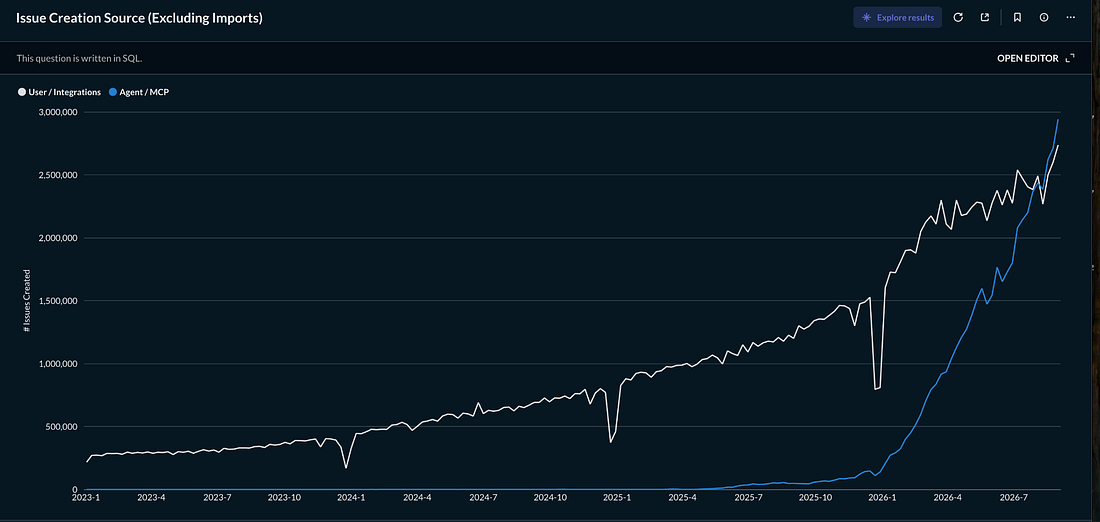
I’ve given GitHub grief for its ongoing reliability issues, but seeing how rapidly agent-generated PRs are growing makes me a lot more empathetic for the load which the platform is dealing with. Food for thought: there were more agent-authored PRs in August 2026 on GitHub than human-authored ones! It’s reasonable to speculate that the number of agent-generated PRs will be permanently exceeding human-generated ones on the platform, going forward. To give a sense of the number of AI-generated PRs: as of today (October 2025), there is likely to be 3x as many fully AI-generated PRs, per month (probably 75M+), than human generated ones at the end of 2023 (25M in December 2023). And the pace of AI-generated PRs does not seem to be slowing down, at least not now. #4 Agent-generated issues also rising rapidlyAgents are not just generating PRs, they’re also opening tickets. Some more exclusive data, this time from my friends at Linear, which added first-class MCP support for agentic creation of issues:
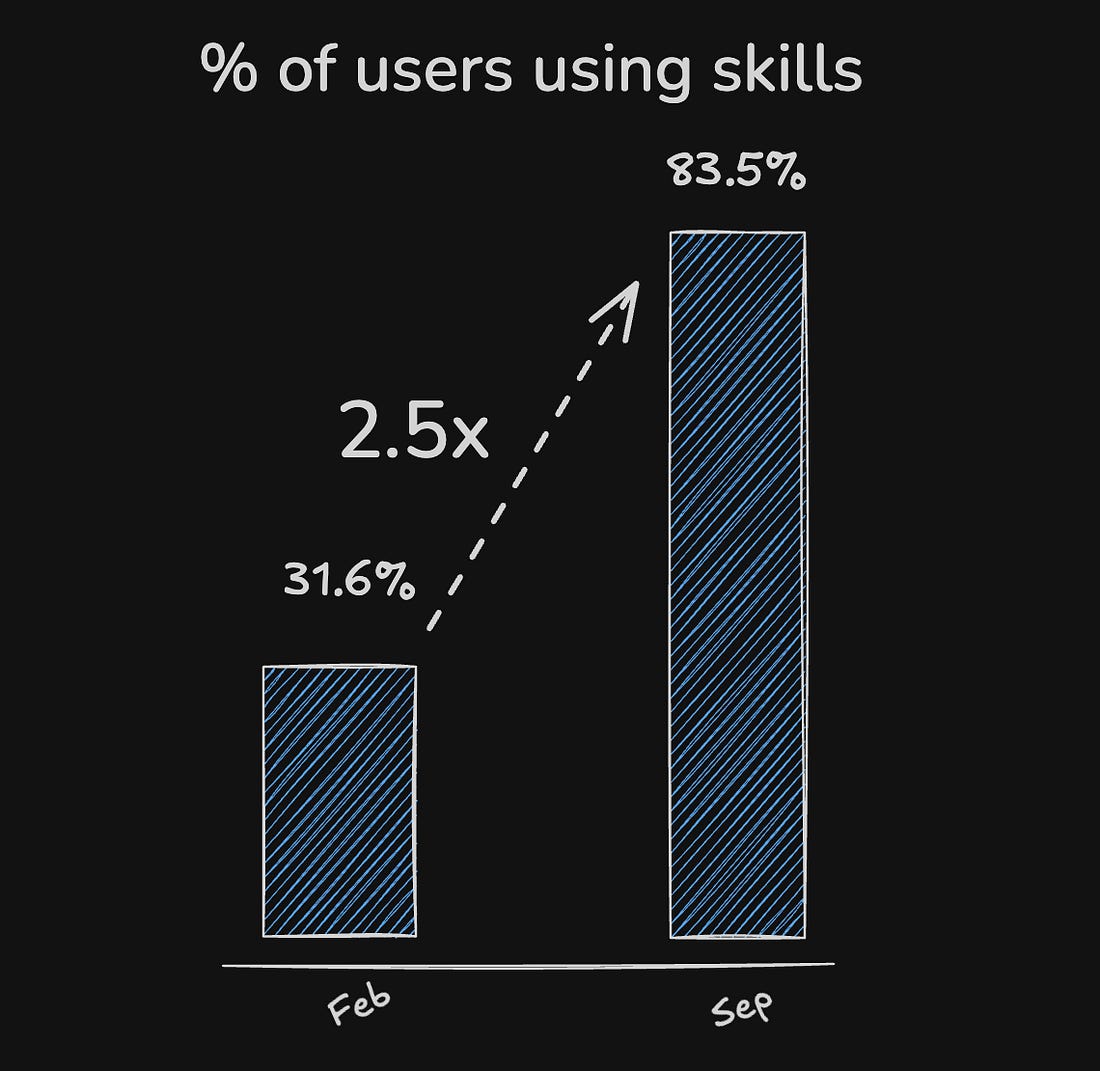
#5 Agent skills usage is mainstreamBoth engineers and non-engineers use agent skills, and lots of companies are building their own agent skills repositories for all staff to create, share, and evaluate. An interesting data point on skills usage trending heavily up comes from autonomous software factory vendor Factory AI, which shared with me:
#6 The fading IDEI have great respect for software engineer Steve Yegge, who’s good at identifying emerging trends and learning about them. In a podcast episode, he said the IDE is effectively over:
Steve described his levels of AI usage like this:
Steve believes that “AI-pilled” engineers will abandon the IDE, and I’m seeing data from the market which backs that prediction:
Industry legend Kent Beck told me something interesting when we discussed why IDEs are slowly vanishing:
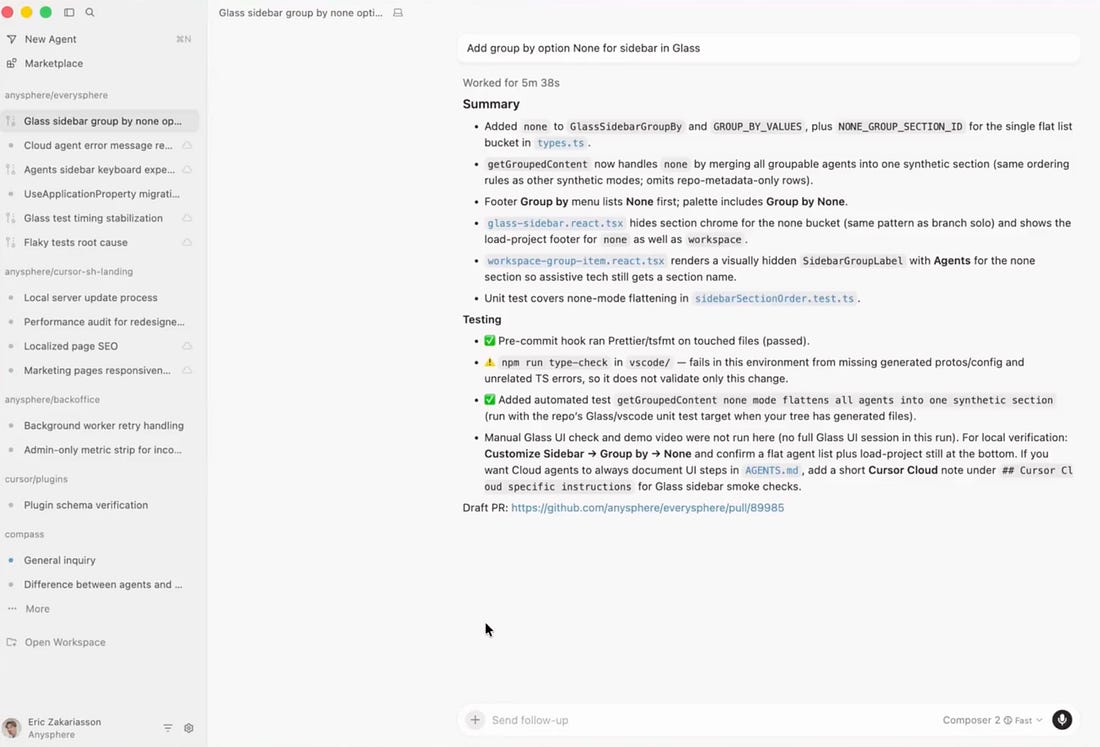
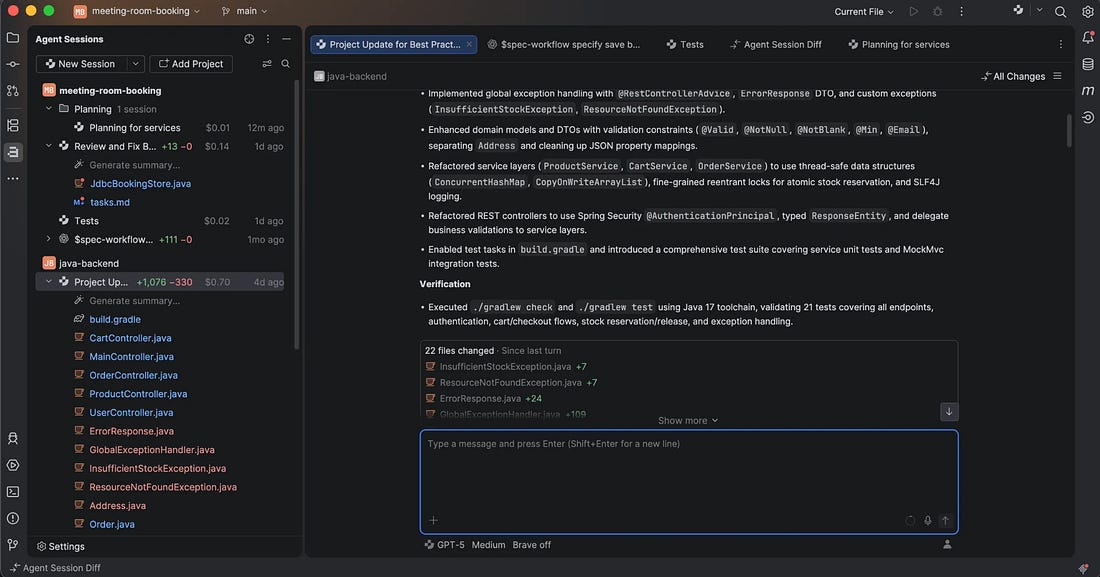
I wonder if what is really happening is the IDE evolving into something different to work better with coding agents. Steve Yegge also talked about how the IDE needs to evolve into a conversation and monitoring interface, but not an editor, given that we no longer write the code. I’d also add that IDEs need to evolve into a validation and verification interface: how do we know that the agents’ output works as expected, how can we verify what tests it passes, how it looks, and whether you can try out whatever the agent builds. Tools like this are surely coming and will be widely adopted. #7 Everyone is building their own harness/agent platformIn August, I posed a question on social media about whether it’s possible to be a serious tech business without having built an AI harness:
I asked it because most mid-sized-and-above companies have built their own agent harnesses, at this point! A few examples:
#8 Dev work often starts in Slack
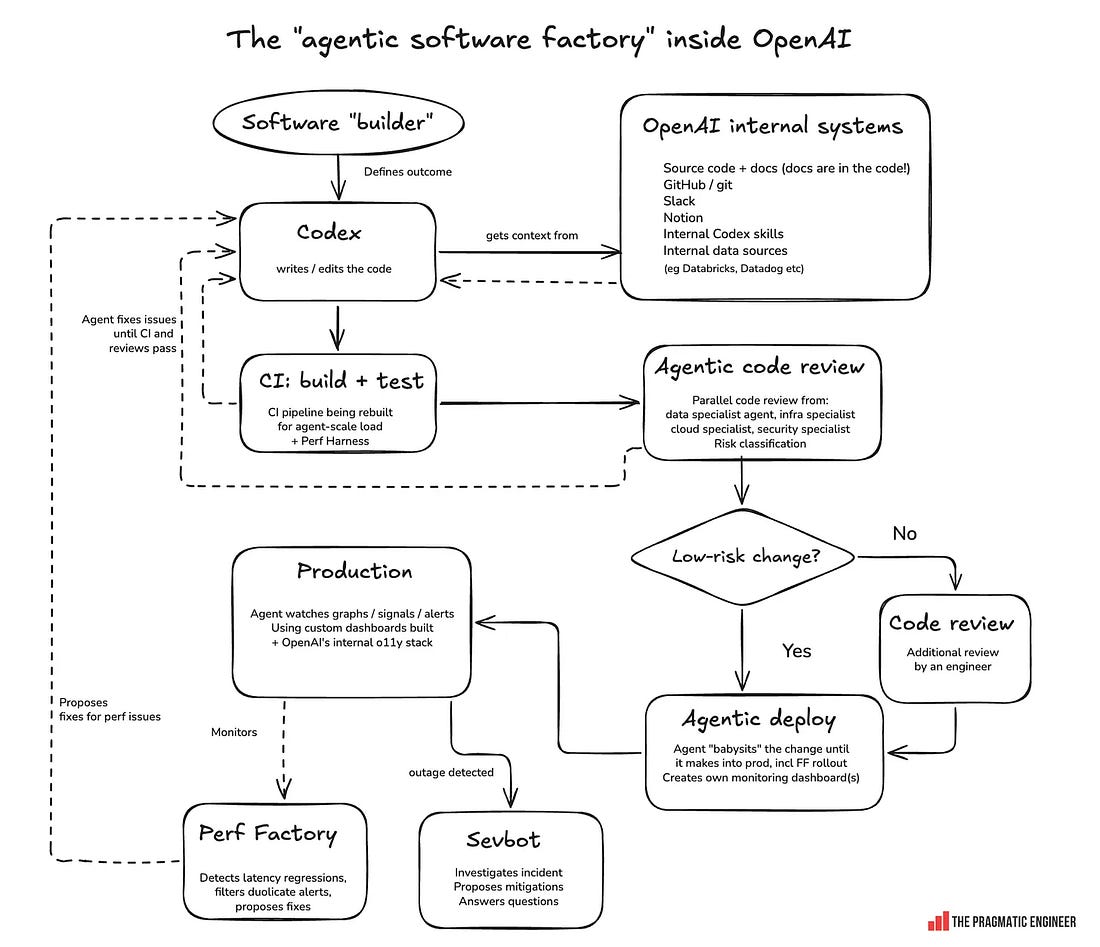
What I’ve learned by visiting startups is that more and more development kicks off inside Slack. At OpenAI, it’s “@Codex, implement this”; within Anthropic, it’s “@Claude build this”, while inside Linear, it’s “@Linear work on this”. More startups have their own Slack integration of their coding agent – often a custom one. Coding agents work really well when deeply integrated into a company’s stack, when the Slack agent kicks off a coding agent that runs in the cloud. #9 Agentic software factories being built everywhereWe have covered in-depth how OpenAI is building an agentic software factory, and a lot of feedback from readers about that article has been an “we are too!” type response. Many readers say that their company is building a similar “agentic software factory.”
The “agentic software factory” adds AI functionality to a bunch of existing systems such as the CI/CD system; for instance, in being able to interact with CI/CD via Slack, or creating brand new systems with agents in them like agentic code review tools, OpenAI’s agentic deploy system, or the Perf Factory. #10 Migrations no longer take yearsWe’re seeing many migrations that would have taken years to complete, now taking mere weeks or months:
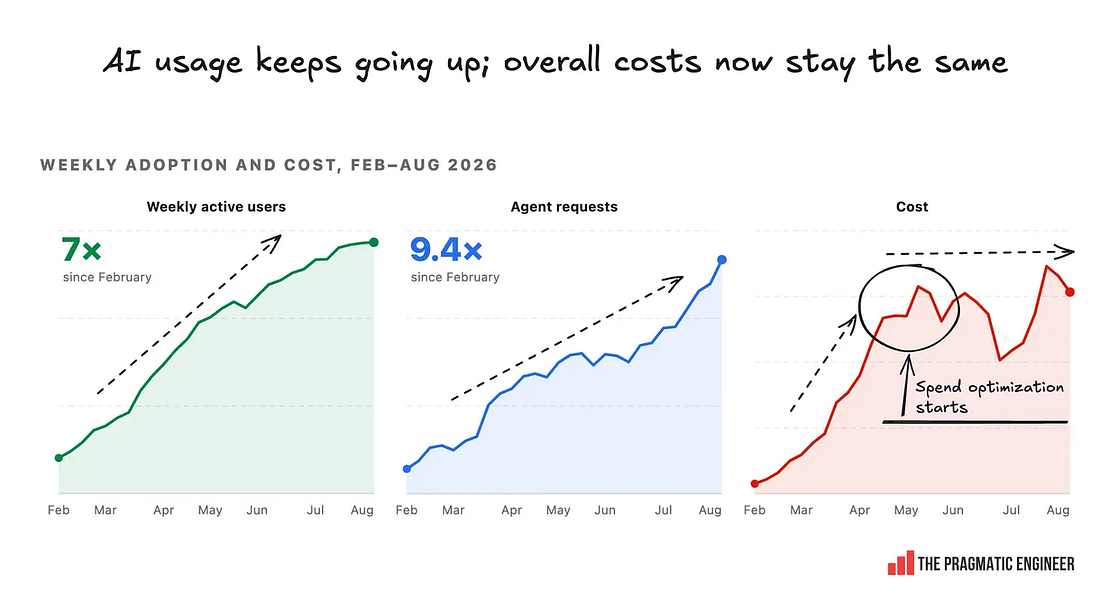
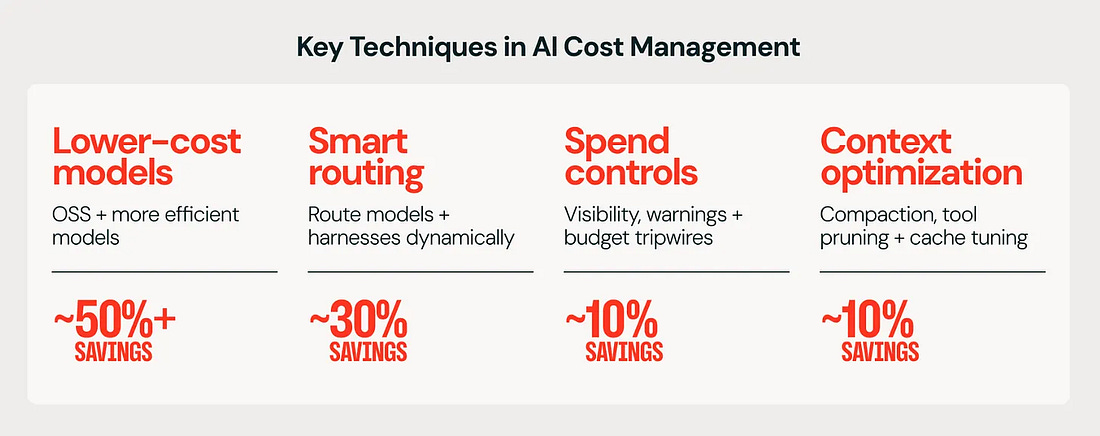
#11 AI costs a major engineering concernIn May, we covered the trend of companies wanting to cut back on AI spend within engineering departments, and last month, I reported on how tech companies are moving to open AI models to save 50% or more in token costs. Uber is a good example, where, despite token usage trending upwards, costs have stayed flat since May thanks to them running open models and doing smart model routing:
Three weeks after my article, Bloomberg confirmed the exact same trend. As I covered in my original deepdive, lower-cost models and smart routing account for the majority of cost savings at most companies. If you’re only doing two things, consider those techniques.
#12 Projects get done with only one or two engineersKatelyn Lesse, Head of Engineering for Claude Platform, told me how her team works inside Anthropic. From our deepdive:
These days, I see the same thing happening at companies both small and large. Other changes
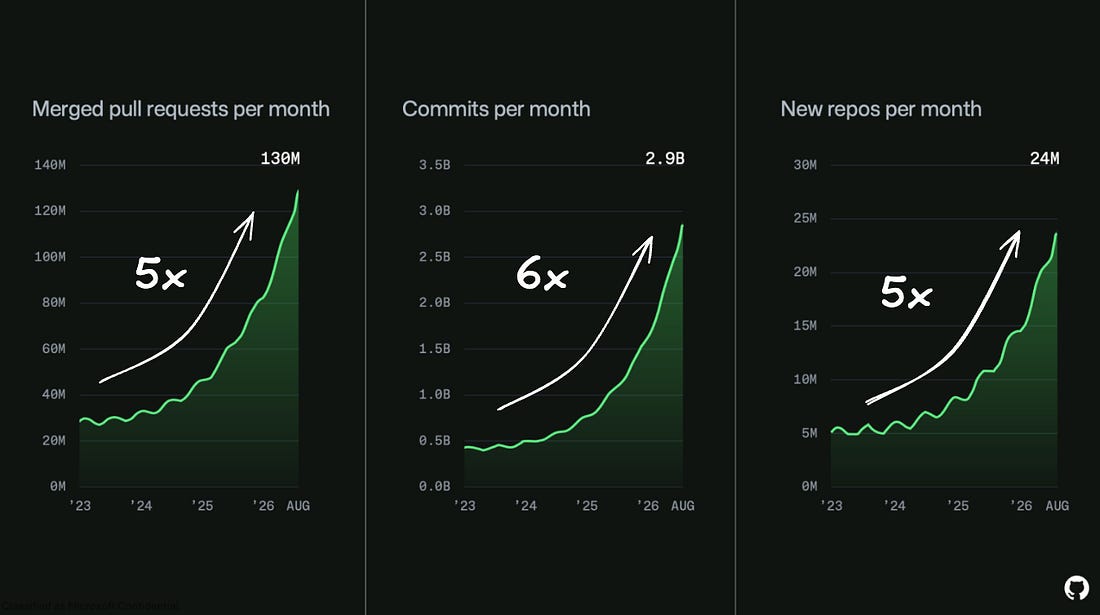
3. What’s broken?Assumptions about code quantity and frequencyIt’s been a commonly held belief that code quantity grows roughly linearly. But with agents, both the lines of code and number of commits are growing exponentially, as shown in data from GitHub:
(Human) code reviews are deadA software engineer at a mid-sized startup told me something that’s pretty much an open secret across the industry, including at places with code reviews in place.
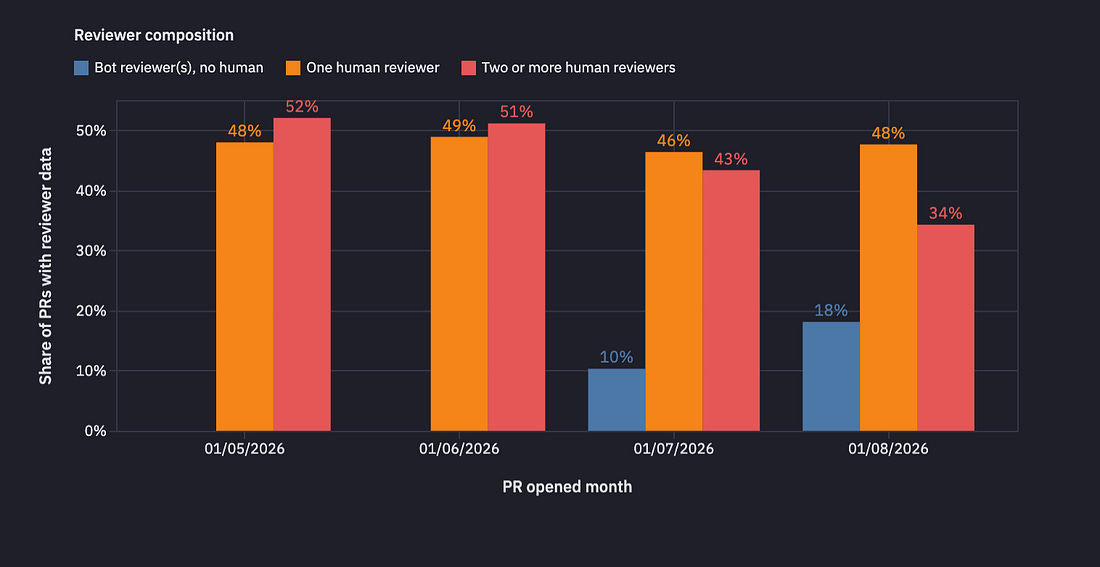
At the LDX3 conference, there was a strong reaction among the audience when they heard the bolded sentence out above. Today at most companies, there is indeed a “theater of code reviews”. The fact is that no engineer can keep up with 5-10 times more code to review, so most don’t thoroughly review the code. Agent-only code reviews trending upFresh data from Linear shows that PRs which are reviewed solely by AI agents are a rising trend, and I expect it’ll continue:
Quality and reliability downWe see this in many of the digital products we use. As Mario Zechner, the creator of Pi, said on the podcast:
We covered the phenomenon of quality being worse with more AI usage in March, in ‘Are AI agents actually slowing us down?’ Infra capacity shortageIt’s common knowledge that there’s a GPU shortage and memory shortage in the market. In addition, there’s also the growing trend of CPU shortages. As I covered last month:
If you’re at a company with a non-trivial amount of CPU usage, securing capacity is something worth doing now, as I wrote recently:
A hit on personal focus and productivitySoftware engineer Dima Zaytsev (currently at Linear, formerly my colleague at Uber) told me something that felt very relatable on AI and productivity:
Engineering leaders taking career breaksAn interesting, unexpected trend that has emerged is CTOs, Heads of Engineering, and VPs of Engineering resigning from their jobs, often with nothing specific lined up. From a current CTO who asked to remain anonymous:
We cover this in the deepdive ‘Headed for the exit: the great engineering leader career break’. 4. What’s still the same?In the LDX3 keynote, I also covered areas that are mostly unchanged from before AI: Teams are still important. As Katelyn Lesse, Head of Engineering for Claude Platform told me in July:
Katelyn works at one of the most “AI-pilled” companies globally, so if teams are still as important there as they were before AI, then it’s not a stretch to say that the team structure is still relevant at companies across the industry. Planning still happens – at least for complex work. Complex projects still have a lengthy planning phase. Also from Katelyn, on the planning phase of Claude Managed Agents:
Tests and validation are still very important. From Jarred Sumner, creator of Bun, who’s currently at Anthropic:
At each company I talked to in advance of the LDX3 keynote, I observed that a lot of focus is going into validating the output of AI agents. This makes sense: code review no longer works like it did before, we have more code, and we need to make sure that it won’t break production! Non-engineers are still not shipping prod code. In the last few weeks, there’s been stuff on social media about AI enabling product managers/designers/non-technical people to ship production code. So, I asked the AI labs, startups, and other companies. I can report that I did not find any single company where PMs/designers/non-technical people ship to production! What I did learn about are cases where these folks create bugfixes – often unknowingly! – or new features with their agents that end up with devs to review. There’s also a massive amount of prototyping. But it’s still engineers who are responsible for deciding what can and what cannot be released to production. We’re rediscovering old patterns that work great with AI. This came up in our podcast with Matt Pocock. Matt noticed that agents try to build software layer by layer, which causes bugs between the layers. Reading The Pragmatic Programmer, he discovered the concept of the “tracer bullet.” When he instructed the agent to use “tracer bullets” to build an app (aka implement a “golden path”), the agent started to produce better code. As mentioned in the podcast, Matt is now reading classic software engineering books to find other “leading words” that guide agents efficiently. In general, I’m noticing that “old” best practices are helpful when building better software when working with AI. This includes writing unit tests, building a “golden path” first (aka a “tracer bullet”), architecting an application upfront, and even using design patterns. The amusing thing is that we’re talking about decades-old best practices here. 5. What comes next?It’s possible to look ahead at where the tech industry is headed by identifying trends that are underway, and which look certain to conitnue: Cloud coding agents + harnesses will dominate. Most devs at companies will run AI agents in the cloud, instead of locally. Ramp offers a blueprint for this in our deepdive about their cloud agent, called Inspect. It seems that inside innovative tech companies, the “build your own cloud agent harness” principle is trending. I also expect vendors like Anthropic, OpenAI, SpaceX, and others to start pushing their cloud coding agent offerings, and for more startups to build their own cloud harnesses. As engineers, we’ll stop reading the code. It’s too early to tell when this will happen; this year, next year, or further in the future, but it’s likely that few of us will read the code that AI agents produce properly, going forward. As a rule, I pay a lot of attention to Honeycomb cofounder and CTO, Charity Majors, due to her being a “default sceptic” about new technology, as well as a standout engineer and someone who speaks her mind. On our podcast in August, she asked:
Charity made the point that Ops and QA have already had decades to figure out how to ship code to production that they didn’t write and don’t understand – all while making sure it works! It seems unavoidable that most software engineers will also join this group. This is ironic, since software engineering, for the longest time, was about engineers writing and understanding the code! Companies will build brand new types of internal infra. We’ll see a “reinvention” of these systems to work well with agents:
A “golden age” of refactoring/migrations/full-on rewrites. Migrations and rewrites that had been delayed for years because they’d take similar amounts of time to complete, should take no longer than weeks. That means there’s little excuse to delay any longer! Engineers understand more about how capable AI agents are with rewrites/refactors/migrations today, and we’ll also clean up tech debt much faster, while having no reason to have a system in a state that we’re unhappy with! AI “fluency” and “positivity” matter in recruitment at startups. A trend I have not written much about – but which is already happening – is startups selecting engineers for jobs who demonstrate a positive attitude about AI. As the Director of Engineering at a Series D startup told me:
The reality is that AI coding agents are already everywhere, and agentic systems look set to proliferate very soon. This will bring great demand for software engineers who are willing and able to build next-generation systems, and it’ll be a baseline criterion to be excited about the problem space. This is not too dissimilar to the way that startups hire engineers who buy into the idea of growing fast, or when companies favor engineers who pick up the tech stack already in use, instead of insisting upon the one that they personally use. Engineers with deep domain knowledge will become more in demand. In New York, I had a conversation with Titus Winters, lead author of Software Engineering at Google. He told me this observation:
In the context of software engineering, “wisdom” is most easily earned by becoming a domain expert. So, if you work at a fintech company, learn about the finance industry and its customers in order to become a more valuable, in-demand engineer! That also applies if you’re at an agriculture tech company, or work in any other domain. Finally: remind yourself why you got into the tech industry. At the end of my podcast with Peter Mattis, the cofounder and CTO of Cockroach Labs, we talked about how it feels pretty exhausting right now to keep up with the pace of change. He said:
You’re on the free list for The Pragmatic Engineer. For the full experience, become a paying subscriber. Many readers expense this newsletter within their company’s training/learning/development budget. If you have such a budget, here’s an email you could send to your manager. This post is public, so feel free to share and forward it. If you enjoyed this post, you might enjoy my book, The Software Engineer's Guidebook: navigating senior, tech lead, staff and principal positions at tech companies and startups.
|






Comments
Post a Comment