From Chrome DevTools to AI Engineering, with Addy Osmani

From Chrome DevTools to AI Engineering, with Addy OsmaniAddy Osmani shares lessons from 14 years at Google and how AI agents are reshaping software engineering, developer workflows, and the skills engineers need to succeed.
Stream the latest episodeListen and watch now on YouTube, Apple, and Spotify. See the episode transcript at the top of this page, and timestamps for the episode at the bottom. Brought to You by
• Antithesis – verify your system’s correctness without human review or traditional integration tests – and avoid bugs or outages. Teams like Jane Street, Fly.io, and the etcd community use Antithesis to ship better code, faster. Learn more. • Sentry – application monitoring software built by developers, for developers. Sentry’s Seer AI agent is one of their new, neat tools, which I’ve used as a way to quickly fix errors on my backend. Check out Sentry. • Google Cloud Run – run untrusted agent code without the security anxiety. Cloud Run sandboxes deliver hyper-isolated, ephemeral execution environments that spin up in milliseconds. Check out Cloud Run sandboxes. In this episodeAddy Osmani spent more than 14 years at Google, working on Chrome, DevTools, Core Web Vitals, and most recently, AI developer experience. If you’ve ever opened Chrome DevTools, or optimized a page for Core Web Vitals, you’ve used software built by Addy Osmani. In this episode, I sit down with Addy and we talk about his path from building a web browser aged just 16 to becoming a director at Google. We discuss what he learned from building tools for millions of developers, Google’s engineering culture, and why he continued doing hands-on coding work as a manager. We also get into how he works with AI agents today, the risks of ‘cognitive surrender,’ his approach to ‘loop engineering,’ and why it’s good to develop skills in product management, go-to-market, and other areas. Takeaways from the conversation with Addy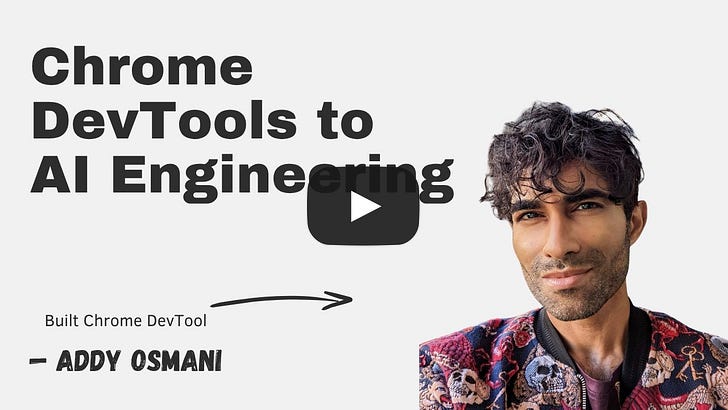
Here are eleven interesting points from the chat with Addy: 1. Addy built a web browser from scratch, aged just 16. Back then, a pain point was that Addy had to carry floppy disks to his local library to download data. To speed up browsing, he built a browser that opened multiple connections when fetching webpages. 2. Publishing free educational materials helped Addy land a job at Google. A documentary about Google which he watched as a youngster made Addy want to work somewhere like it. Later, Google noticed his work in publishing educational resources about frontend and JavaScript development. The company reached out about a DevRel-and-builder role, and Addy was hired to join the Chrome team. 3. Chrome DevTools was an effort by Google to meet web developers in the browser. Today, DevTools is one of the closest things Google has to an IDE (not counting Antigravity, that is), but the project started as a way to add tools to the browser to help debug web applications. As web engineers started to use more complex frameworks and build chains, DevTools added capabilities like source-map-aware debugging, hiding library code, mobile device emulation, tooling for service workers, and more. 4. Most developers don’t understand memory management. Addy says this is because memory debugging tooling has not advanced in a decade, and remains a hard problem to solve. This is despite making improvements in runtime performance debugging in Chrome DevTools (flame graphs and deep tracing). 5. Becoming accountable on a weekly basis for a top company goal is the biggest difference in a director of engineering at a major tech company. Addy worked his way up from engineer to Director of Engineering at Google, and I asked what the biggest change was when he made it to that level. Being on the hook and reporting regularly on a top company goal was something he found entirely new, Addy said. 6. A big culture shift at Google in the last two years has been VPs and SVPs coding on weekends. Naturally, this is because AI tools make coding much easier. During his last two years at Google, it was common for these folks to talk about their weekend side projects and tools they used to build them. 7. A big risk of AI-assisted development is cognitive surrender. Addy defines cognitive surrender as the erosion of your comprehension of the problems being worked on, and of your own memory of what’s going on. He recommends pushing back against this by understanding every major decision an LLM makes. Unfortunately, his former method of reading the AI’s entire reasoning process is no longer practical given how much output agents can generate, but you’ll still want to understand the most important decisions. 8. Aim for mutual amplification when using AI tools. The aim is to do two things simultaneously:
9. Addy believes software engineers will always be important because an AI model cannot be accountable. Accountability for code and software is possible even if the accountable party didn’t write the code, as is the case in projects like Chromium, where designated engineers own parts of the codebase. They’re responsible for approving and rejecting contributions, and for shaping that part of the codebase. Addy reckons that a “what am I accountable for?” mindset will be adopted by many software engineers. 10. Addy is bullish about software engineering’s outlook. Every time the profession has made it easier to create software, we’ve created exponentially more software. Addy predicts the same will happen with AI, and that the total addressable market of people building software will get much bigger. 11. Advice on where to invest efforts as engineers in the coming years. In his words:
The Pragmatic Engineer deepdives relevant for this episode• Inside Google’s engineering culture • How AI-assisted coding will change software engineering: hard truths • Are AI agents actually slowing us down? • From IDEs to AI Agents with Steve Yegge • Google’s engineering culture: the podcast Timestamps00:00 Intro 02:50 Addy’s current workflow 05:11 Addy’s path into tech 15:04 Addy’s work on jQuery 16:44 TodoMVC 21:44 Getting hired at Google and working on Chrome 27:17 Building dev tools 40:15 Core Web Vitals 45:42 Google’s engineering culture 51:03 Addy’s career trajectory at Google 57:55 The director role at Google 1:01:40 Cognitive debt and cognitive surrender 1:03:03 Working with agents 1:05:52 Loop engineering 1:12:55 The changing role of the software engineer 1:18:15 How Addy uses AI in writing 1:27:40 What’s next for Addy 1:28:47 Career advice ReferencesWhere to find Addy Osmani: • LinkedIn: https://www.linkedin.com/in/addyosmani • Website: https://addyosmani.com Mentions during the episode: • Beyond Vibe Coding with Addy Osmani: https://newsletter.pragmaticengineer.com/p/beyond-vibe-coding-with-addy-osmani • Borland: https://en.wikipedia.org/wiki/Borland • jQuery: https://jquery.com • John Resig on X: https://x.com/jeresig • AngularJS: https://angularjs.org • Backbone.js: https://backbonejs.org • YUI: https://github.com/yui/yui3 • Ext JS: https://en.wikipedia.org/wiki/Ext_JS • Sindre Sorhus’s website: https://sindresorhus.com • Speedometer: https://browserbench.org/Speedometer3.0 • Next.js: https://nextjs.org • Grunt: https://en.wikipedia.org/wiki/Grunt_(software) • Firebug: https://en.wikipedia.org/wiki/Firebug_(software) • Pavel Feldman on LinkedIn: https://www.linkedin.com/in/pavel-feldman-24b0041 • Paul Irish on LinkedIn: https://www.linkedin.com/in/paulirish • Paul Bakaus on LinkedIn: https://www.linkedin.com/in/paulbakaus • Impeccable: https://impeccable.style • Visual Studio: https://visualstudio.microsoft.com • Yang Gao on LinkedIn: https://www.linkedin.com/in/yang-gao-08567b51 • Understanding Core Web Vitals and Google search results: https://developers.google.com/search/docs/appearance/core-web-vitals • Google’s engineering culture: https://newsletter.pragmaticengineer.com/p/googles-engineering-culture • Inside Google’s Engineering Culture: Part 1: https://newsletter.pragmaticengineer.com/p/google • Inside Google’s Engineering Culture: the Tech Stack (Part 2): https://newsletter.pragmaticengineer.com/p/google-part-2 • Simon Hørup Eskildsen’s website: https://sirupsen.com • Pushing software engineering limits with “napkin math”: https://newsletter.pragmaticengineer.com/p/pushing-software-engineering-limits • Loop engineering: https://addyosmani.com/blog/loop-engineering • What is “loop engineering?”: https://newsletter.pragmaticengineer.com/p/what-is-loop-engineering • Peter Steinberger on X: https://x.com/steipete • Boris Cherny on X: https://x.com/bcherny • Ryan Dahl’s post on X: • The Effective Software Engineer: How ICs at Every Level Can Leverage AI, Prioritize High-Value Work, and Lead Beyond Their Role: https://www.amazon.com/Effective-Software-Engineer-Prioritize-High-Value/dp/B0FMJ5XVSD • Leading Effective Engineering Teams: Lessons for Individual Contributors and Managers from 10 Years at Google: https://www.amazon.com/Leading-Effective-Engineering-Teams-Contributors/dp/109814824X • Beyond Vibe Coding: From Coder to AI-Era Developer: https://www.amazon.com/Beyond-Vibe-Coding-AI-Era-Developer/dp/B0F6S5425Y • Michael Novati on LinkedIn: linkedin.com/in/michaelnovati • “The Coding Machine” at Meta with Michael Novati: https://newsletter.pragmaticengineer.com/p/the-coding-machine-at-meta — Production and marketing by Pen Name. You’re on the free list for The Pragmatic Engineer. For the full experience, become a paying subscriber. Many readers expense this newsletter within their company’s training/learning/development budget. If you have such a budget, here’s an email you could send to your manager. This post is public, so feel free to share and forward it. If you enjoyed this post, you might enjoy my book, The Software Engineer's Guidebook: navigating senior, tech lead, staff and principal positions at tech companies and startups.
|

%26stroke%3Dnone%26strokeWidth%3D3.6)






Comments
Post a Comment